
When someone in Australia is diagnosed with breast cancer, they often turn to Breast Cancer Network Australia (BCNA). For more than 25 years, BCNA has been the national voice for people affected by breast cancer, providing trusted information, peer support, and advocacy for equitable access to care.
But in a country as vast as Australia, where millions live outside major cities and internet connectivity can be patchy, delivering support digitally isn’t easy. That’s where Mouseflow helped BCNA transform how they understand and support their community online.
“Mouseflow turns data into empathy. It helps us see our website through the eyes of people who are living with breast cancer and their supporters.”
Susanne Porter, Head of Health Information Content, BCNA
The challenge: Understanding behavior beyond numbers
BCNA’s website is the heart of its mission. It is where thousands of Australians go to find reliable information about diagnosis, treatment, and recovery, or simply to connect with others who understand what they are going through.
Over time, the digital ecosystem has grown complex. They had seven different products, each on separate platforms, and users had to sign in seven different times to access them. There were more than 600 pages of health information, plus hundreds more for events, fundraising, and advocacy. Over two years, BCNA worked to bring everything together into one cohesive platform.
The team relied on Google Analytics (GA4) and Ahrefs to understand traffic, but those tools only told part of the story.
For a small charity without a dedicated analytics team, that lack of visibility made it hard to prioritize what to fix. And the stakes were high. Many BCNA visitors arrive moments after receiving a diagnosis. The website isn’t just a source of information, it is often their first lifeline.
As Susanne explained, someone will come to the website completely overwhelmed and terrified, and the team’s job is to make sure that person leaves feeling calmer, more informed, and knowing they are not alone.
“We had all this quantitative data, but no idea why users behaved the way they did. We could see drop-offs, but we didn’t know where or why they were happening.”
Susanne Porter, Head of Health Information Content, BCNA
The challenge of distance
Australia’s geography added another layer of difficulty. With people spread across the continent, often in rural and remote areas, connectivity issues were a major barrier to access. They had to make sure people could still see and use our site even with low bandwidth.
The team wanted to know if users in those regions could load images, read articles, and access forms. Were slow load times causing people to give up before finding support? Without a way to see what users were actually experiencing, BCNA couldn’t answer those questions.
The turning point: Seeing the “why” with Mouseflow
When BCNA adopted Mouseflow, everything clicked into place. Susanne describes Mouseflow as “the body language of our website.” It was the missing piece that revealed how users moved, hesitated, and interacted in real time.
“We use GA4 and Ahrefs for numbers and SEO, but Mouseflow tells the story behind the data. It’s the human lens. It’s our immediacy and our clarity.”
Susanne Porter, Head of Health Information Content, BCNA
With session recordings, the team could finally see what was happening for users, not as abstract data points but as real people navigating the site. They would get feedback like, ‘This page won’t load,’ and Susanne would replay the session to find the real cause. Often it wasn’t a design problem at all. Their bandwidth couldn’t handle the image size. That’s something you’d never discover from analytics alone.
That discovery led to concrete changes:
- Optimizing images
- Simplifying layouts, and
- Removing unnecessary animations so the site worked for everyone, no matter where they lived or what device they used.
Making analytics human
One of Mouseflow’s biggest impacts at BCNA was not only in what it revealed about user behavior but also in how it changed the team’s relationship with data. Susanne’s team isn’t made up of data analysts. They are content designers and communicators. Mouseflow’s visual tools, especially heatmaps, made data instantly understandable to anyone and easy to act on. The team started using heatmaps to test new page layouts, find better places for calls to action, and evaluate campaign performance.
It also became an advocacy tool for getting buy-in from leadership. Instead of relying on intuition, the team could now show clear visual evidence of how visitors interacted with content. When a page was too long or confusing, it was no longer a matter of opinion. Everyone could see where users stopped scrolling or lost interest.
This made analytics accessible to the whole organization. It turned data into something human, something that told a story about how real people experience BCNA’s website.
Discovering friction and the emotional side of UX
As BCNA expanded its use of Mouseflow, Susanne’s team began exploring Friction Score, which automatically detects all user frustrations and errors on the website.
What they discovered reshaped how they think about user experience. Around 78% of their friction comes from dead clicks. People try to interact with elements that don’t do anything, and for them, that’s not just a technical problem. It’s emotional.
For BCNA, friction isn’t just about usability. It’s about empathy. A confusing button or unresponsive element can heighten frustration for someone who is already in distress.
“Most of our visitors come straight after a diagnosis. They’re scared, exhausted, and overwhelmed. We shouldn’t be the place that adds more frustration. Detecting friction helps us design calmer, more supportive experiences.”
Susanne Porter, Head of Health Information Content, BCNA
Rebuilding journeys around people
When BCNA launched a complete website redesign, Mouseflow’s Journeys became essential to measuring its success. The new information architecture reorganized hundreds of pages into more intuitive pathways, and Mouseflow helped prove that the changes were working.
These insights guided further refinements, helping the team ensure users move seamlessly from information to community, support, or donation pages. Before, they could only guess. Now they can see exactly what’s happening and respond in real time.
This continuous visibility turned their redesign into a living project, one that evolves based on how people actually experience it.
“I’ve been able to see that our engagement increased by over 20% immediately after the redevelopment. And now I can see not just that people stay longer, but where they go next. What pages they click on. What captures their interest. And how they move through the site.”
Susanne Porter, Head of Health Information Content, BCNA
Real-world results
Since relaunching its website, a project informed throughout by Mouseflow insights, BCNA has seen measurable improvement:
- 91% increase in visitors
- 25% higher engagement overall, with an immediate 20% jump after launch
- 18% decrease in sign-up drop-offs
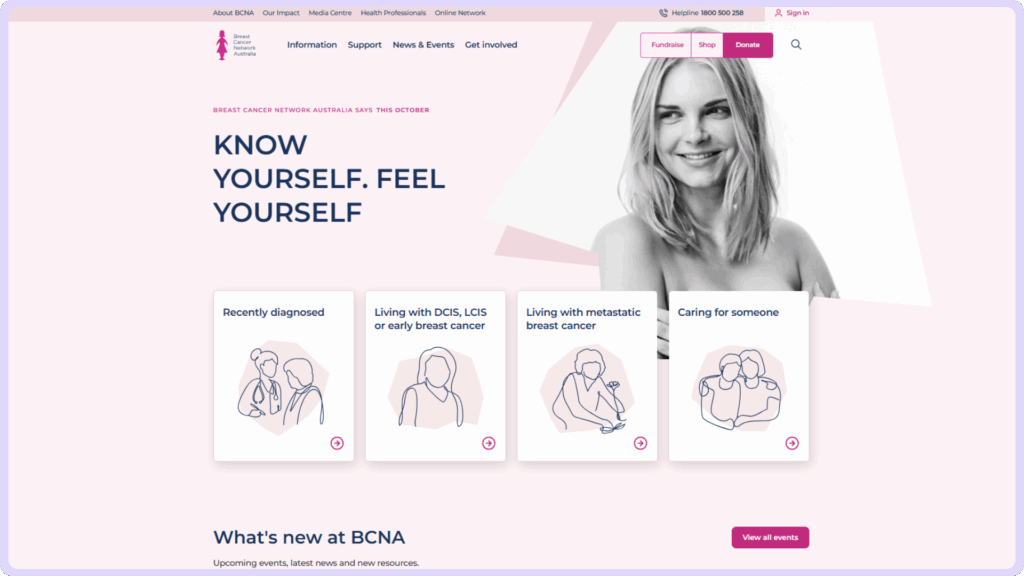
BCNA Homepage
Beyond the numbers, Mouseflow has helped BCNA prove its impact to corporate sponsors and donors. Heatmaps and visual reports are now part of the team’s presentations to partners, showing clear evidence of how their contributions drive meaningful engagement.
“For the first time, we’ll be able to follow a donation from the first click all the way through. It’s going to completely change how we optimize the experience.”
Susanne Porter, Head of Health Information Content, BCNA
A culture built on empathy and evidence
Mouseflow didn’t just make BCNA’s website better. It helped them work in a new way. Data is no longer abstract or intimidating. It is a daily part of how the team creates compassionate digital experiences.
“I spend about an hour a day in Mouseflow. It’s not just a tool. It’s another team member with a skill set we couldn’t afford otherwise. At the end of the day, Mouseflow is empathy. It lets us see what our community is feeling, not just what they’re clicking. And for a health organization, that’s priceless.”
Susanne Porter, Head of Health Information Content, BCNA
Susanne’s message to other organizations is simple, start small and stay curious: “You don’t need a data team to make meaningful change. We started with one heatmap, and it made a difference immediately. Don’t be afraid to begin. Even a single insight can improve someone’s experience.”
BCNA’s journey shows that analytics isn’t just about optimizing clicks. It’s about understanding people, their emotions, frustrations, and needs, and designing experiences that meet them where they are.
With Mouseflow, BCNA turned data into empathy. And in doing so, they made their digital presence not just more effective, but more human.
Company: Breast Cancer Network Australia
Tools used: Mouseflow, GA4, Ahrefs
Features used in Mouseflow: Heatmaps, Session Replay, Journeys, Friction