70% of the buying journey is over before you know the buyer exists.
That number sounds like a brand awareness argument. It’s actually a conversion argument.
By the time a target account lands on your website, they’ve already done the research, formed opinions, and in many cases decided whether you belong on the shortlist. Your ABM campaign got them there. What happens next is almost entirely determined by the experience they find when they arrive. And most ABM teams have no idea what that experience actually looks like.
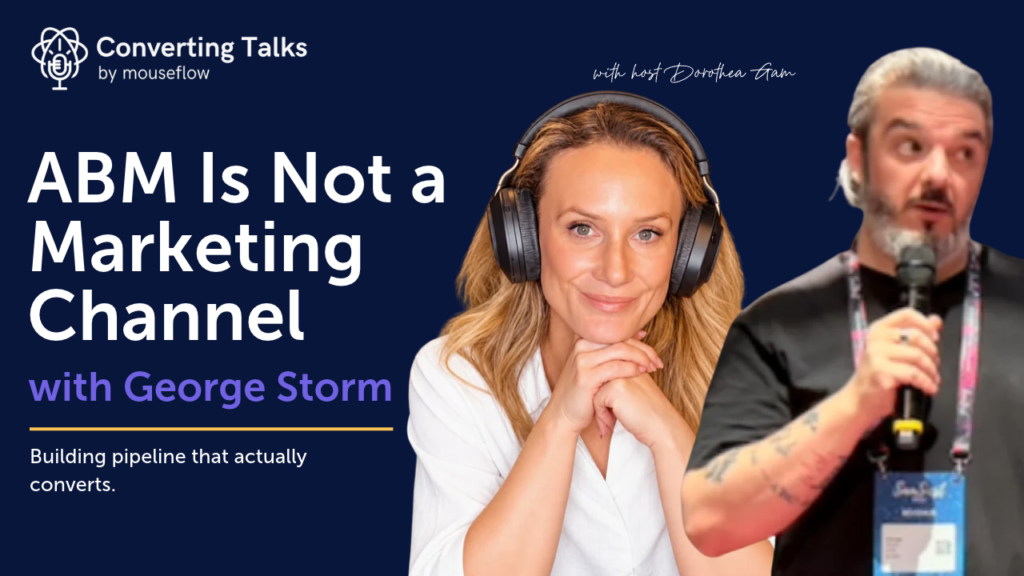
George Storm, CRO at N.Rich, joined me on a recent episode of the Converting Talks podcast to talk about ABM as a full-funnel motion. And the conversation kept coming back to the same gap, the one between the ad and the door.

The shortlist forms before you show up
George calls it the day 1 battle. When a company starts evaluating a solution, buying committees are already narrowing their list based on familiarity. If your brand hasn’t been present during the long, quiet stretch before evaluation starts, you don’t get considered, even if your product is exactly what they need.
“If your brand is nowhere to be found when they start building a shortlist, then even if someone cold calls them and says we have a great solution — at that point it’s a bit too late. You end up in column five.”
This is why George views ABM not as a campaign channel but as a full-funnel motion. With buying committees that have nearly tripled in size over the last two years, reaching a single champion isn’t enough. The CFO who signs off, the CRO who co-owns the budget, the IT lead who approves the integration, if none of them have heard of you before the evaluation starts, the odds shift against you before you’ve said a word.
The implication for the website is direct. When a target account finally does land on your site, they’re not arriving cold. They’ve arrived with expectations shaped by everything they’ve already seen about you. The on-site experience either confirms or breaks what your ABM built.
The gap between the ad and the door
This is the part of ABM that rarely gets measured. George described it in a way that stuck with me:
“It’s like looking at pictures of a restaurant when you’re deciding where to book, and then walking in and finding chaos. You saw a tailored message. You clicked. And then you land somewhere that doesn’t make any sense – and the interest you had just disappears.”
The targeting was right. The creative was right. And then the visitor arrived at a slider that didn’t load, navigation that made no sense, and no clear signal about what to do next.
This is exactly what Session Replay surfaces. Not that someone left, your analytics already told you that, but what they did in the 90 seconds before they did. Where they paused. What they tried to click. Where the page failed to follow through on the promise of the ad. When you’re investing in getting high-value accounts to your site, watching a handful of those sessions each week is one of the highest-leverage things your team can do.
Heatmaps tell a different part of the same story. If the value proposition your ABM campaign led with isn’t visible above the fold, or if the case studies your target persona cares about are sitting below a scroll depth most visitors never reach, that’s not a creative problem. It’s a page structure problem, and it shows up in behavior before it shows up in conversion rates.
The mistake that doubles the cost
Running ABM campaigns to a website experience you’ve never actually watched is what George called a double minus. You spend to get the right account there. Then a broken experience does the brand a disservice on top of wasting the spend.
Friction Detection is built for exactly this. Every session gets a Friction Score based on signals like rage clicks, dead clicks, and JavaScript errors. When high-intent traffic, the accounts your ABM is targeting, is hitting your site with a high friction score, you’re not just losing a conversion. You’re burning an impression on exactly the accounts you need to win.
Journey Analytics shows the paths visitors actually take through your site, which content sequences lead to high-intent pages, and where the journey breaks down. For ABM teams trying to understand whether target accounts are reaching the pages that matter, pricing, case studies, the demo page, this closes a loop that campaign reporting was never built to close.
What it actually takes to close the loop
George’s advice for where to focus AI investment in ABM was more practical than most: start with harmonizing your funnel data. Not the flashy use case. The unglamorous work of connecting what’s happening at every stage so you can make decisions based on what’s actually true.
“The biggest thing AI has helped me with is having a full understanding of what’s happening in the funnel from the first touch point down to renewal. Now you can actually make strategic decisions based on data instead of trying to A/B test your way out of forecasting.”
That’s the same shift behavioral analytics enables at the website layer. You stop guessing why high-value traffic isn’t converting and start seeing it. Session Replay, Heatmaps, Friction Detection, and Journey Analytics don’t replace your ABM platform. They complete the picture it was always missing, what happens after the click.
ABM gets the right accounts to your site. Mouseflow shows you what they do when they get there. The gap between those two things is where most ABM ROI quietly disappears.
Listen to the podcast
George Storm joined Dorothea Gam on Converting Talks by Mouseflow to talk ABM, the day one battle, and what AI has genuinely changed about the way revenue teams operate. Listen to the full episode →