Somewhere between 30 and 40% of your click IDs disappear before a conversion is recorded.
That’s not a rounding error. That’s a structural feature of modern paid marketing, the result of cross-device journeys, consent settings, long B2B sales cycles, and the simple fact that the person who clicked your ad last Tuesday is rarely the same person who signs the contract three weeks later.
And yet most marketing teams are still trying to build a direct line from ad spend to revenue, expecting their attribution model to explain the full story. It can’t. And when it falls short, the campaigns, not the model, get blamed.
Eddie Casado, Performance Marketing Lead at Lucen Software, put it plainly in a recent episode of the Converting Talks podcast:
“I cannot optimize anymore for ads that drive revenue. If I do, the numbers look too tiny and then your campaigns are all underperforming.”
This isn’t a confession of defeat. It’s the most honest thing a performance marketer can say. And it points to something more important: there’s a layer of the funnel that attribution was never built to see.

The click is not the beginning of the story
For years, the paid channel owned the top of the funnel: clicks, CTR, impression share, cost per acquisition. These are all real signals, and they matter. But they measure what happens before someone lands on your site, or at the moment of conversion. What they skip entirely is everything in between.
That in-between space, the 90 seconds where a visitor scrolls your landing page, hovers over your pricing, re-reads your headline, and then either converts or closes the tab, is where purchase decisions actually happen. And it is completely invisible to your attribution model.
This is what behavioral analytics is built to see.
Session Replay shows you the actual path a visitor took through your page: where they paused, what they skipped, what confused them enough to leave. Heatmaps show you whether your value proposition was ever seen, or whether it sat below a fold nobody scrolled past. Friction Detection surfaces rage clicks, dead clicks, and hesitation patterns that signal something is wrong before it shows up in your conversion rate.
None of this cares what campaign brought the visitor in. It shows you what happened once they arrived, which, in paid marketing, is often the only part of the story you still have full visibility into.
Attribution tells you the outcome. Behavior tells you why.
The practical split Eddie described is the right one: optimize your ads for what ads can control: click-through rate, search impression share, quality score, on-page conversion signals. Then look at business-level data (ARR trends, domain-level patterns, revenue shifts when you increase or reduce budget) to understand marketing’s broader impact.
What this model misses is the feedback loop in the middle: why are on-page conversion rates low? Why does traffic from one campaign segment convert at half the rate of another? Why do visitors who land on your highest-spend keyword page bounce faster than organic visitors?
Those answers don’t live in your ad platform. They live in the session.
When you can see that 60% of paid visitors are dropping at the same form field, you don’t need a bigger budget. You need to fix the field. When your heatmaps show that visitors from a specific campaign never scroll to your social proof section, you have a page structure problem, not a targeting problem. When Form Analytics reveals that your highest-exit field is the one asking for a phone number, that’s a decision worth making.
What closing the gap actually looks like
Eddie’s biggest unlock wasn’t a smarter bidding strategy, it was offline conversions: feeding real customer data back to the platforms so the algorithm could learn from actual outcomes rather than just clicks. The data flowing into the platform gets smarter.
But the data that should also be flowing back to your team is behavioral. The patterns in how your best customers behaved before they converted. The friction points that consistently appear in sessions that almost converted but didn’t. The content that high-intent visitors spend the most time with.
This is what turns a flat conversion rate into an optimization roadmap:
- Watch sessions that convert not just the fact that they did, but the path. Which pages sealed it? What did the winning journey look like?
- Watch sessions that nearly convert a visitor who reaches your trial signup and stalls is telling you something a conversion rate never will.
- Track friction, not just funnel stage rage clicks and dead clicks are conviction leaking out of your page in real time.
- Compare behavioral patterns across traffic sources if paid visitors behave differently on-page than organic ones, the problem may not be the ad.
The part attribution can’t solve
The marketers adapting fastest right now aren’t the ones with the most sophisticated attribution models. They’re the ones who’ve accepted that some of the funnel will always be dark, and who’ve shifted their attention to what’s still fully visible: the session itself.
Attribution tells you someone clicked. Behavioral analytics tells you what they did with the next 90 seconds. In a world where ad budgets are under pressure and conversion rates are flat, that second answer is worth more than the first.
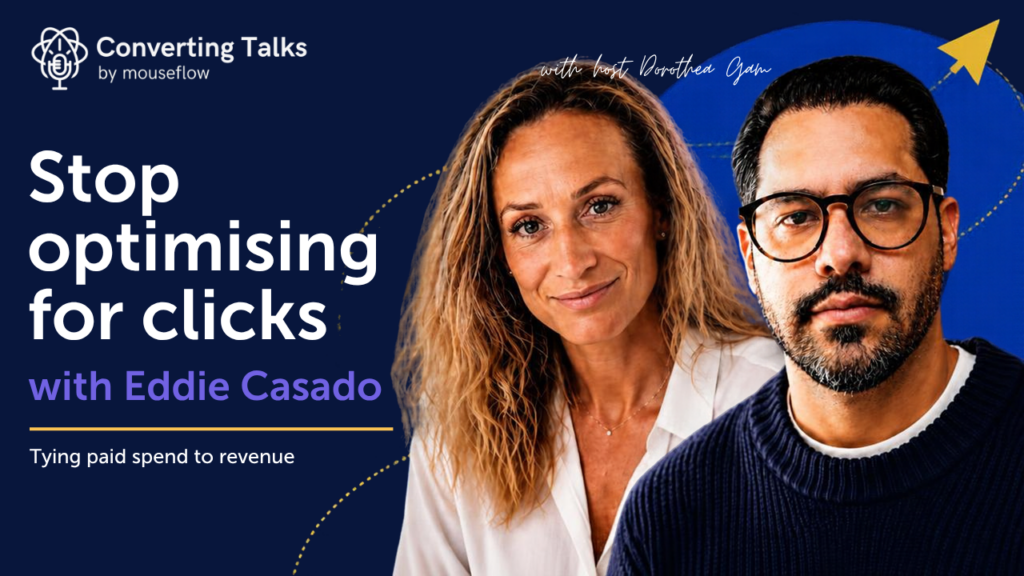
“Stop Optimising for Clicks” with Eddie Casado on tying paid spend to revenue
Eddie Casado joined Dorothea Gam on Converting Talks by Mouseflow to talk performance marketing, attribution, and what it really takes to connect paid spend to revenue. Listen to the full episode →