The gap between what they say and what they do is not a research problem. It is your most valuable insight.
Ask users if they found what they were looking for. Most will say yes. Watch their Session Replay and you will see them scroll past the answer three times before giving up and leaving the page.
The feedback you collected was not wrong exactly, it just wasn’t telling the whole story.
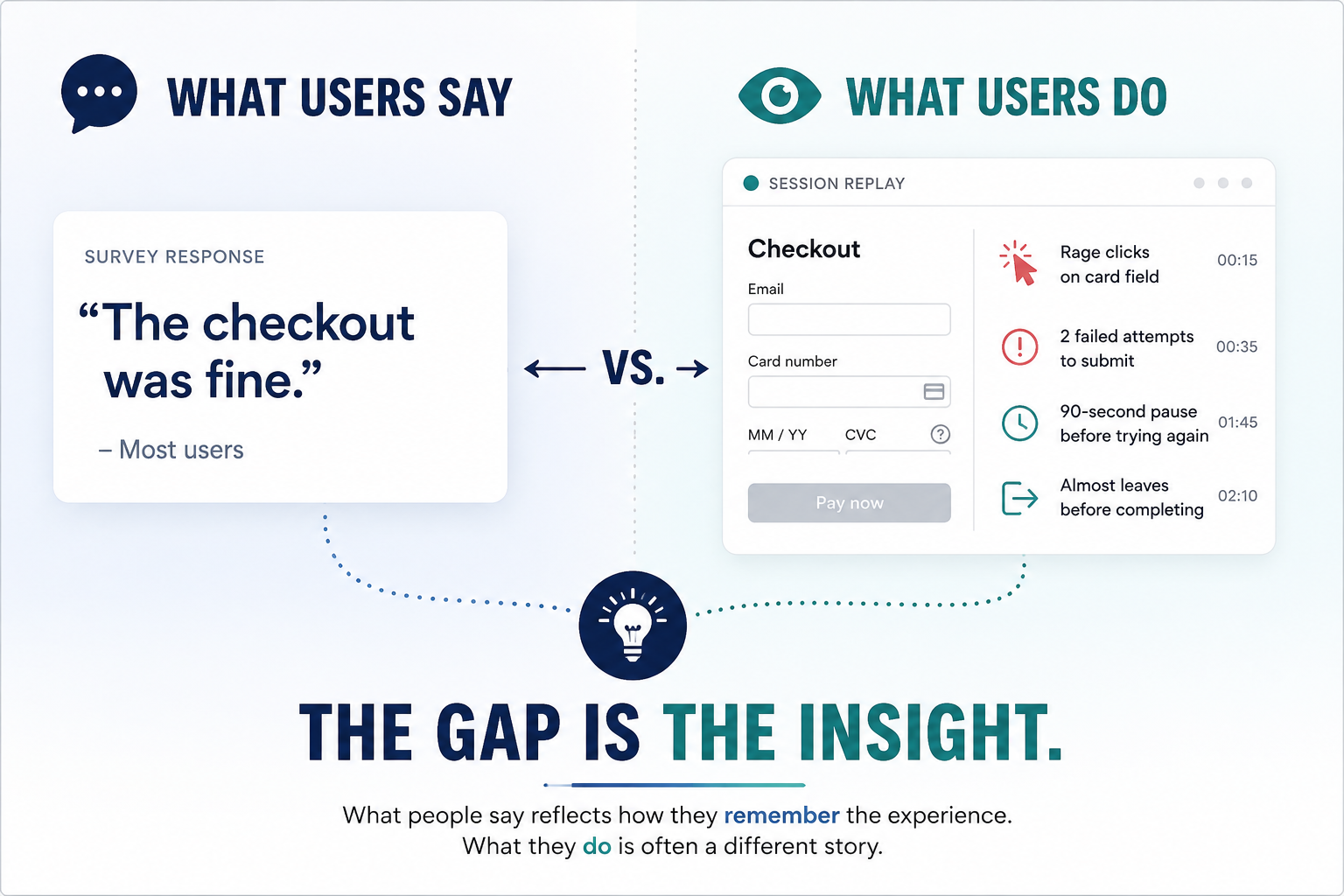
What people say reflects how they remember the experience. What they did is often a different story.

When Feedback and Behavior Tell Different Stories
A checkout that involved two failed attempts and a moment of genuine confusion can still be remembered as “fine” if it eventually worked. What users report reflects their perception of the experience, while their behavior captures moments they may not remember, notice, or consider worth mentioning.
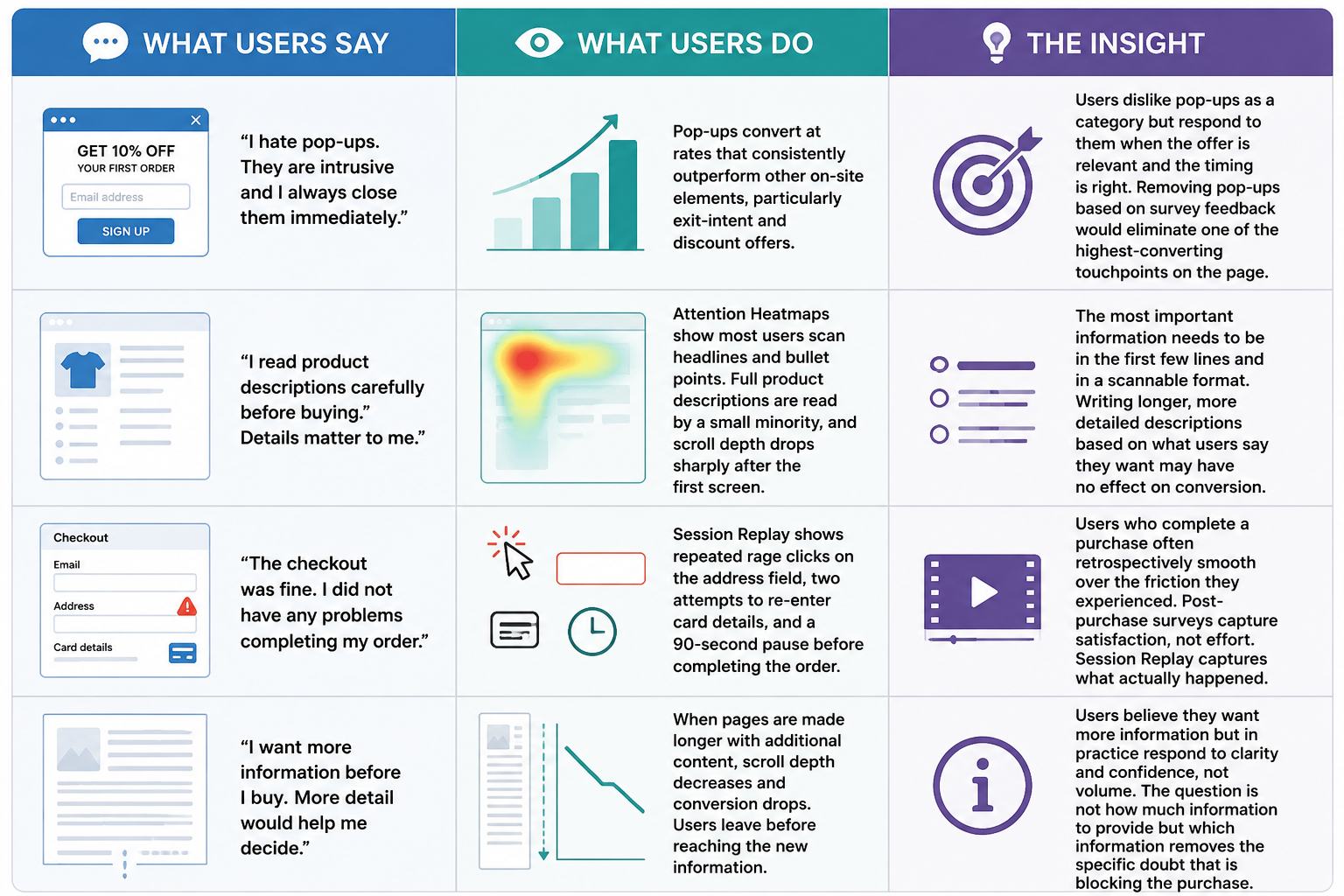
And checkout is only one example. Users may say they read product details carefully while Heatmaps show they barely engage with them. They may say they hate pop-ups while those same pop-ups drive conversions. Or they may ask for more information while their behavior shows they are already overwhelmed by what is on the page.
These contradictions are not necessarily signs that your data is unreliable. They are signals that there is more to understand.
The Contradiction Is the Insight
The value is in what the disagreement reveals. Behavioral data shows what happened, but the why still requires interpretation. Feedback adds the user’s perspective. When the two don’t match, that contradiction becomes a clue.
It can reveal friction users have normalized or expose problems that neither source would make obvious on its own.
Instead of asking which source to trust, ask what the contradiction is telling you.
When Friction Becomes Normal
One of the most useful things a contradiction can reveal is normalized friction: unnecessary effort users have experienced so often that they no longer recognize it as a problem worth mentioning.
Direct friction is easier to spot. A broken button, a failed payment, or a form that does not work as expected creates an obvious obstacle. The priority is straightforward: fix what is broken.
Indirect friction is harder to see, especially when it becomes normalized. The experience technically works, but users have learned to accept unnecessary effort as part of the process. They might re-enter information, click several times, or search in multiple places without thinking of it as a problem. These small moments can add up until continuing feels like too much effort. And because nothing is obviously broken, the solution is different: instead of repairing an error, the goal is to remove effort users should never have needed in the first place.
When that friction goes unnoticed, the impact goes beyond UX. Repeated friction can get in the way of the journeys that drive activation, conversion, and retention. A checkout abandoned because the process felt like too much effort means a lost conversion, and when the same kind of friction affects key journeys over time, the impact can extend to retention, revenue, and customer lifetime value.