Ruben de Boer has spent over fifteen years figuring out why people do what they do online, and what to do about it. He’s a freelance CRO and experimentation consultant with clients like Vodafone, eBay, and Rabobank, and over 27,000 students in his Udemy courses on CRO and online psychology. When Dorothea visited Amsterdam, they sat down in Ruben’s apartment to talk about the state of experimentation: where AI is genuinely helping, where it’s creating new problems, and what it actually takes to build a culture where every decision is rooted in data.
Here are the key ideas from their conversation.

AI is a bottleneck-remover, not a decision-maker
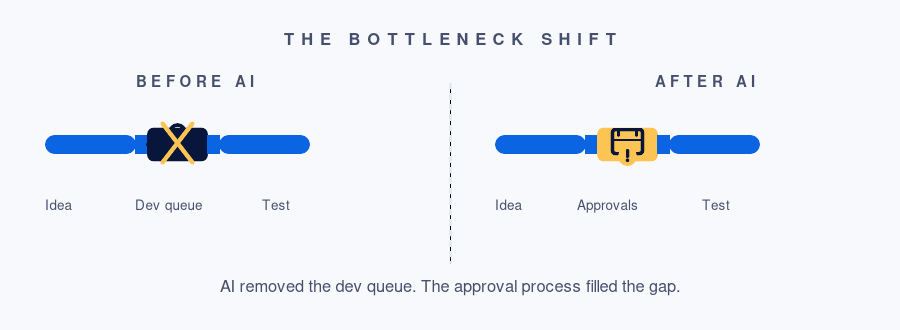
For years, the biggest constraint in AB testing was development time. CRO specialists had ideas for experiments, but had to queue behind engineers to get them built. AI has largely removed that bottleneck, especially for client-side testing. Most testing platforms now have prompt-based experimentation built in, and tools like Claude or ChatGPT can generate experiment code in minutes.
But Ruben is careful not to overstate what this means.
“In one prompt you can build a whole team of agents,” he says, “but it does not mean those agents are delivering quality.”
The same principle applies to AI-assisted data analysis. AI can process large sets of user research, survey responses, and reviews faster than any human. That’s genuinely useful. But the quality of the output depends entirely on the quality of what goes in. “Garbage in is still garbage out,” Ruben says. “This rule we have had for many, many years and it still applies today.”
The pitfall he sees most often: teams automating too much and removing the human judgment that makes experimentation valuable in the first place. You need to know what good quality looks like before you can tell whether AI is delivering it. If you don’t have that baseline, you’re just moving faster in the wrong direction.
Psychology is the foundation, not the finishing touch
Ruben started thinking about behavioral psychology in CRO back in 2007, before the field had a name for it. He was helping a coaching company with their marketing and realized: if people can change behavior offline, why couldn’t that same thinking apply to website design?
He read scientific articles and books on social psychology. He wrote a book about it. At Online Dialogue, he worked alongside actual psychologists. The result is a perspective that most CRO practitioners haven’t reached yet: psychology isn’t a list of tactics to apply, it’s a lens to understand what’s actually happening in your experiments.
“There are 250 psychological biases,” Ruben says. The mistake is to pick one, design an experiment around it, and move on. That’s backwards. The right approach starts with your users.
- Start with research. Use tools like Mouseflow to understand what people are actually doing on your site. Read user research. Look at reviews. Find the real problems, not the assumed ones.
- Name the customer opportunity. Translate the research into a clear customer problem statement: “I’m not sure this product will work for me,” or “I don’t trust this brand.” That’s concrete. That’s something you can test against.
- Then bring in the psychology. Once you know what the customer problem is, the relevant psychological principle often becomes obvious. That’s when social proof makes sense to test, or commitment and consistency, or certainty. Not before.
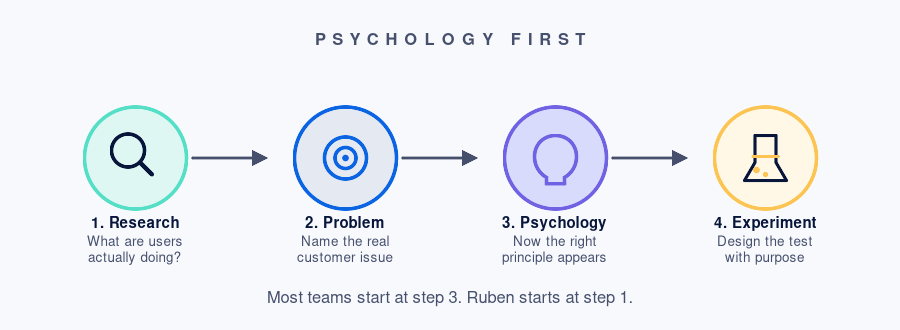
This approach generates a much richer pipeline of experiments and clearer learning from the results. Because you know what you were trying to solve, you can actually interpret what happened.
AI hasn't resolved the real bottlenecks in experimentation
Here’s something counterintuitive Ruben has observed: even though AI has made experiment setup faster, many teams aren’t running significantly more experiments. The development bottleneck is gone, but another one has taken its place.
Approval processes. Design review cycles. Too many stakeholders in the loop. A weekly meeting where every experiment needs sign-off, and if something needs a change, you wait another week.
“The bottleneck just shifted,” Ruben says.
This is worth paying attention to for any team investing in AI for CRO. The speed gains are real, but only if the organizational process around experimentation can match the new pace. If your approval chain takes two weeks, you’re not running more experiments just because an AI wrote the code in five minutes.
The teams that are genuinely increasing their experimentation velocity have done the harder work: fixing the process, not just the tooling.
Experimentation maturity isn't a checklist
Ruben recently co-published a research report on experimentation maturity with fellow consultant Lucius van der Brink, based on interviews with 15 industry leaders. The finding that stuck with him most: experimentation maturity doesn’t sit cleanly on a linear scale.
Every organization is different. What level 3 means for a large e-commerce brand is not what it means for a B2B SaaS company. The maturity model is useful for starting a conversation, not for giving teams a number and telling them to level up.
What does mature experimentation actually look like? According to Ruben, it’s when every decision in an organization is made through experimentation. Not just digital. Not just AB tests. The full scope: marketing decisions, product decisions, strategic decisions. When teams think experiment-first by default.
“Most companies are not there,” he says.
For the CMO who thinks CRO is handled because there’s a team and a tool: “I would say you’re in the wrong department.” At high maturity, experimentation belongs under product or tech, not marketing, because it’s embedded in how the whole organization makes decisions.
For teams that are still building the culture, Ruben’s advice is to stop trying to push experimentation as a practice and start showing how it helps people achieve their own goals. “Show that you can help them achieve their goals with your experiments.” That creates internal advocates. That’s how momentum builds.
When is an AB test actually done?
This is a question with a surprisingly precise answer, and most teams get it wrong.
The right way: before you start the test, use a sample size calculator to determine how long the test needs to run, based on your weekly visitors, weekly conversions, and the minimum uplift you want to be able to detect (the minimum detectable effect). If the calculator says four weeks, you run it for four weeks. No more, no less.
The wrong way: running the test until it hits significance, then stopping. This is called “peeking” and it inflates false positive rates. You’re essentially giving yourself unlimited chances to get a lucky result.
“You determine beforehand how many weeks, and you stick to that,” Ruben says.
What about tests that show no difference at the end? That’s not a failure. It’s information. If you have sufficient data and the variants performed identically, that tells you something about your users. Dig into the behavioral data, look at session recordings or heatmaps, and use it to build better hypotheses for the next test.
Practical advice for teams just starting out
Ruben’s starting point for anyone new to experimentation: find your bottleneck first.
You don’t need to understand experimentation maturity at an organizational level to do good work. You need to know what’s slowing you down most right now, and remove it. That creates results. Results create credibility. Credibility creates room to do more.
You’re also not responsible for the whole organization’s approach to experimentation when you’re just getting started. Focus on running good tests, learning from them, and showing their value to the people around you.
One practical rule: run as many tests as you can, but keep them isolated. If you change ten things in one experiment, you won’t know which one drove the result. If you run ten experiments, each testing one hypothesis, you’ll learn ten things. “The more tests you do, the more winners you will find, the more you will learn, the more successful you’ll be.”
Listen to the podcast
Listen to the full episode on Converting Talks by Mouseflow, or find it on podcast.mouseflow.com and wherever you get your podcasts.