
SaaS and e‑commerce marketers are navigating faster shifts than ever before. Conversion Rate Optimization (CRO) has moved past simple button tweaks and now centers on understanding intent, building trust, and shaping seamless experiences. With acquisition costs rising and customers expectations rising, even small conversion gains can make a big impact on ROI.
In 2026, five trends are shaping which teams pull ahead and which fall behind. Below, we break down each trend and explain how you can act on it, with Mouseflow as your partner in execution.

1. AI‑driven personalization and actionable insights
What’s happening:
AI isn’t future talk anymore. It’s part of daily optimization. Instead of manually creating variants and waiting on test results, AI now helps generate variations, run tests, and highlight opportunities fast. Predictive segmentation lets you tailor messages and offers in real time based on in‑session behavior. This isn’t about replacing humans. It’s about amplifying them. Smart teams use AI to accelerate work, then apply human judgment to validate and prioritize outcomes.
How Mouseflow supports this:
Mouseflow’s AI engine, Mina, automatically scans session recordings to find meaningful patterns and user friction. Rather than spending hours digging through replays, teams can ask natural‑language questions and get instant insights on where users struggle. Mina doesn’t just point out problems. It helps inform what to test next. That means faster decisions, clearer priorities, and more momentum in your optimization cycles.
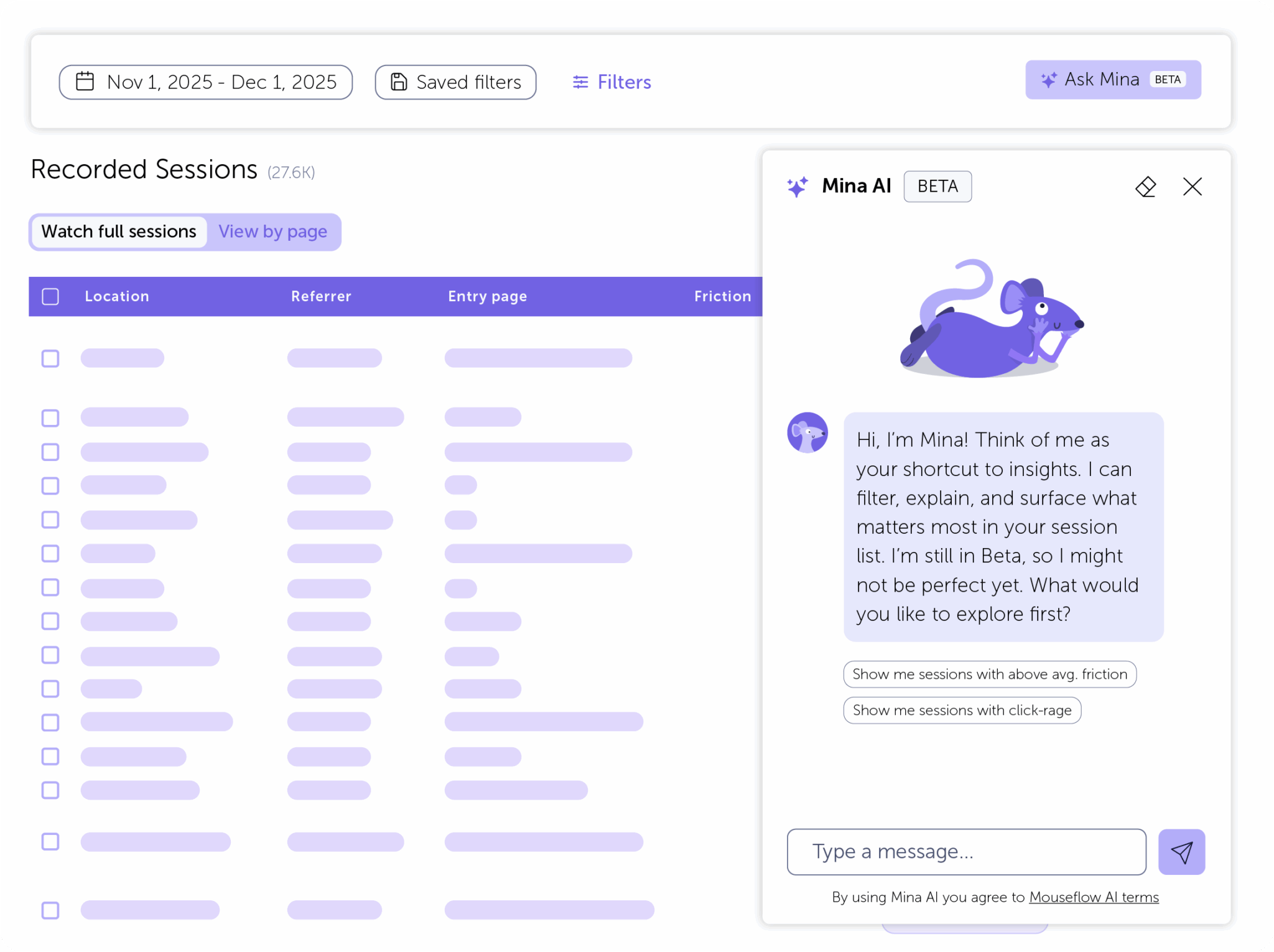
Mina AI by Mouseflow
2. Optimize journeys, not just pages
What’s happening:
User attention is spread across devices, channels, and interactions. Today’s journeys aren’t a single click. They might start on search, continue in chat, and finish in a mobile app or email. High traffic alone doesn’t guarantee conversions if the path isn’t smooth. The focus has shifted from optimizing isolated pages to understanding how experiences flow from one touchpoint to the next. Supporting user intent at each stage, not forcing a rigid funnel, is how teams retain engagement and guide users toward meaningful actions.
How Mouseflow supports this:
Mouseflow’s Journey Analytics reveals how different visitor segments move through your site. Instead of guessing where friction happens, you see the actual paths users take, where they drop off, and which sequences correlate with conversions. This holistic view lets you remove blockers, reinforce consistent messaging, and improve key micro‑conversion moments like demo requests or cart additions. It’s about treating conversion as a series of connected interactions. Not a single event.
3. Privacy and trust are conversion drivers
What’s happening:
Privacy isn’t optional. With third‑party cookies disappearing and regulations tightening, marketing teams must rethink tracking. But personalization still matters. The answer is consent‑safe data practices and transparency that earn user trust. Today’s customers scrutinize brands for clarity and authenticity before converting. Visible trust markers like security badges, clear policies, and real reviews often influence conversions more than design tweaks.
How Mouseflow supports this:
Mouseflow was built with privacy in mind. It offers GDPR and CCPA compliance, anonymous session tracking, and tools to mask sensitive data. Rather than relying on old‑school third‑party cookies, Mouseflow focuses on first‑party behavioral insights that respect consent. You can also collect direct user feedback through surveys, showing visitors that you value their input. When users see that your data practices are respectful and transparent, trust increases. So do conversions.
4. Behavioral insights tell you what, where, and why
What’s happening:
Data alone isn’t enough. In 2026, leading teams pair quantitative metrics with deep behavioral context. That means combining analytics with session replays, heatmaps, funnel analysis, form insights, and on‑page feedback to understand not just what users do, but why they do it. Teams that connect the dots between behavior and intent can pinpoint real friction points and target fixes that move metrics.
How Mouseflow supports this:
Mouseflow provides a suite of behavioral tools that capture every click, scroll, and interaction while protecting privacy. You can watch session replays to see UX issues firsthand, use heatmaps to gauge attention and engagement, and analyze form behavior to spot drop‑off triggers. Mouseflow’s friction detection highlights sessions where visitors hit obstacles, helping you prioritize what to fix. With this level of clarity, teams make decisions confidently. No more guessing or arguing over interpretations.
5. Make experimentation continuous and collaborative
What’s happening:
One‑off redesigns and occasional A/B tests have given way to a culture of constant optimization. Consumer behaviors shift quickly. Teams need rapid feedback loops to keep pace. The organizations that learn fastest are the ones that test, learn, adjust, and repeat. But the point isn’t just speed. It’s learning about real user problems and aligning teams across marketing, product, analytics, and UX to solve them together.
How Mouseflow supports this:
Continuous experimentation thrives on timely insights and clear signals. Mouseflow delivers both. Real‑time behavioral data and automated alerts like friction flags help teams spot issues early and define test ideas with confidence. Instead of long waiting periods, teams can quickly gather evidence on problem areas and spin up experiments that matter. By reducing research time and highlighting meaningful insights, Mouseflow keeps your optimization loop tight and your teams aligned.
Key take-aways
The major digital trends for 2026 center on intelligence, experience, user understanding, trust, and agility. Marketers and CRO teams who thoughtfully use AI, design around full journeys, respect privacy, decode user behavior, and embed optimization into their culture will be positioned to win.
These trends reinforce one another. Tools like Mouseflow help make them operational, turning strategy into action and data into clarity. In a world that never stops changing, the biggest advantage is your ability to learn quickly and act with confidence. Teams that embrace these principles won’t just keep pace with the landscape. They’ll shape it.