
AI is changing more than how people search. It is changing how they discover products, evaluate options, and arrive on ecommerce websites in the first place.
For years, ecommerce discovery was built around browsing. Users searched broadly, compared options manually, opened multiple tabs, and gradually narrowed down their choices.
Now, more of that process is happening before users ever reach your website.
Instead of browsing through pages of results, people increasingly ask direct questions and receive curated answers. The journey from intent to decision becomes shorter, faster, and far less exploratory.
That changes what ecommerce websites need to do.
As discovery becomes more efficient, users arrive with higher expectations and less patience. They expect product pages to answer immediately, navigation to feel intuitive, and checkout to require minimal effort.
This is why ecommerce website optimization is becoming more important, not less. AI is not replacing ecommerce websites, but it is raising the bar for them.

We’re moving from “searching and browsing” to “asking and receiving answers”
Traditional ecommerce behavior was built around exploration.
A user searching for wireless headphones a few years ago would likely move through a long decision-making process. They would compare brands, browse category pages, read reviews, check Reddit discussions, watch YouTube videos, and revisit products multiple times before deciding what to buy.
Search engines acted as gateways into that journey.
AI-driven discovery changes the role of search entirely.
Instead of manually gathering information across ten different tabs, users increasingly expect systems to synthesize information for them. They ask specific questions and receive condensed recommendations, comparisons, and summaries almost instantly.
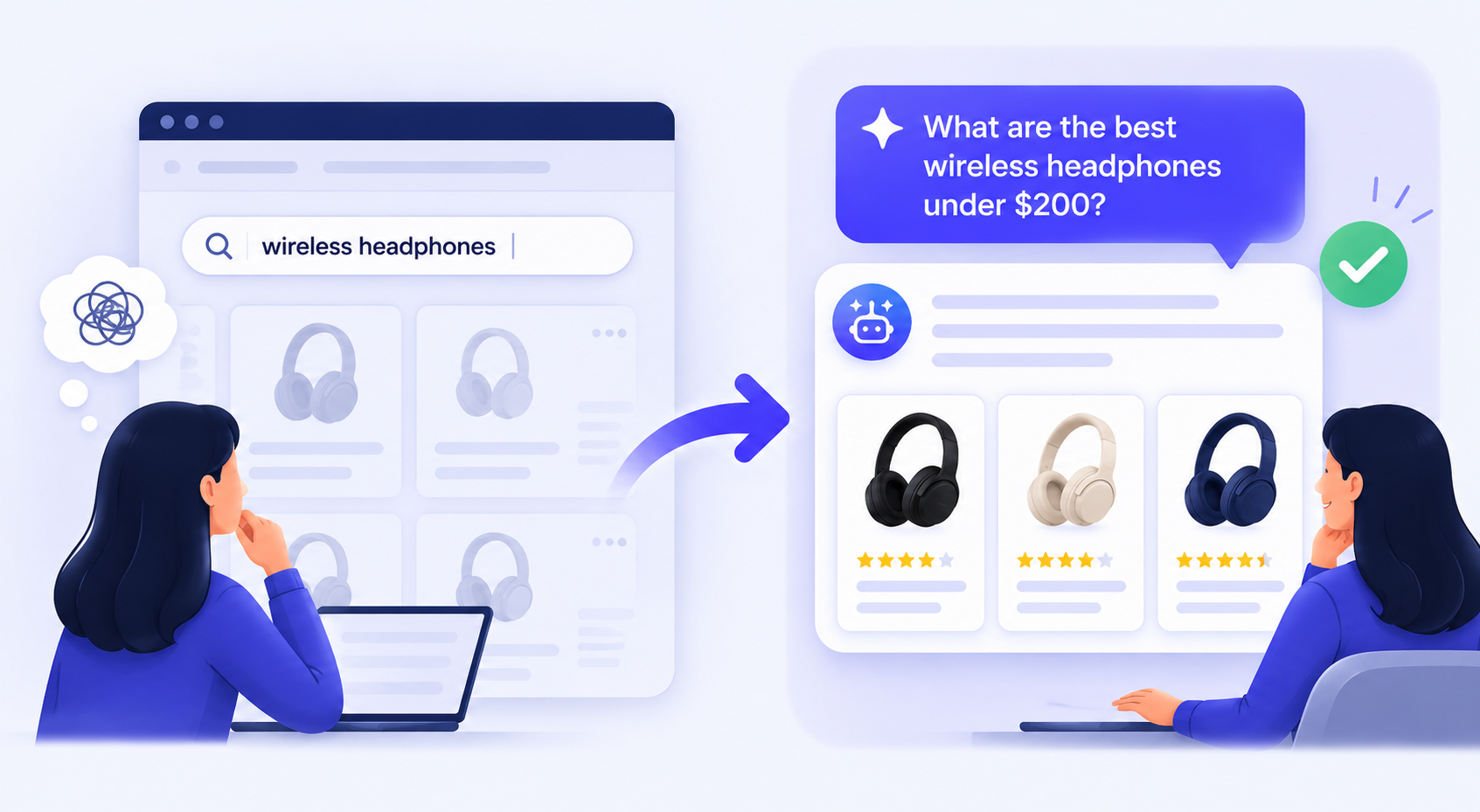
AI is shifting ecommerce discovery from browsing products to receiving curated answers.
That shift may sound subtle, but it fundamentally changes the relationship between users and ecommerce websites.
In the old model, much of the evaluation happened on the website itself. Ecommerce stores were designed around browsing behavior because browsing was how users made decisions.
In the new model, users often arrive after part of the evaluation has already happened elsewhere.
That means ecommerce websites increasingly receive visitors who are:
- more informed
- closer to making a decision
- less willing to spend time figuring things out on their own
And that changes the margin for error dramatically.
A confusing category structure that users might previously have tolerated during a long browsing session suddenly becomes a reason to leave. Product pages that fail to answer practical questions immediately create friction faster than before. Weak UX becomes more expensive because users arrive with stronger intent and shorter patience.
AI is effectively compressing the discovery phase and shifting more pressure onto the experience that follows.
The eCommerce funnel is quietly shrinking
One of the biggest consequences of AI-driven discovery is that parts of the traditional ecommerce funnel are beginning to disappear.
Historically, ecommerce journeys contained long exploratory phases. Users spent time browsing categories, comparing alternatives, researching extensively, and revisiting products before feeling comfortable making a purchase.
AI-assisted discovery shortens many of those steps.
Users increasingly arrive having already narrowed down options through AI-generated recommendations, conversational search experiences, personalized feeds, or summarized comparisons. Instead of beginning the journey on your site, they often arrive somewhere in the middle of it.
This creates a very different kind of ecommerce visitor.
The old visitor was exploratory. The new visitor is often validation-driven.
They are no longer asking:
“What are my options?”
They are asking:
“Is this the right choice?”
That distinction matters enormously because validation-driven visitors behave differently. They scan faster, abandon faster, and are far less forgiving of uncertainty.
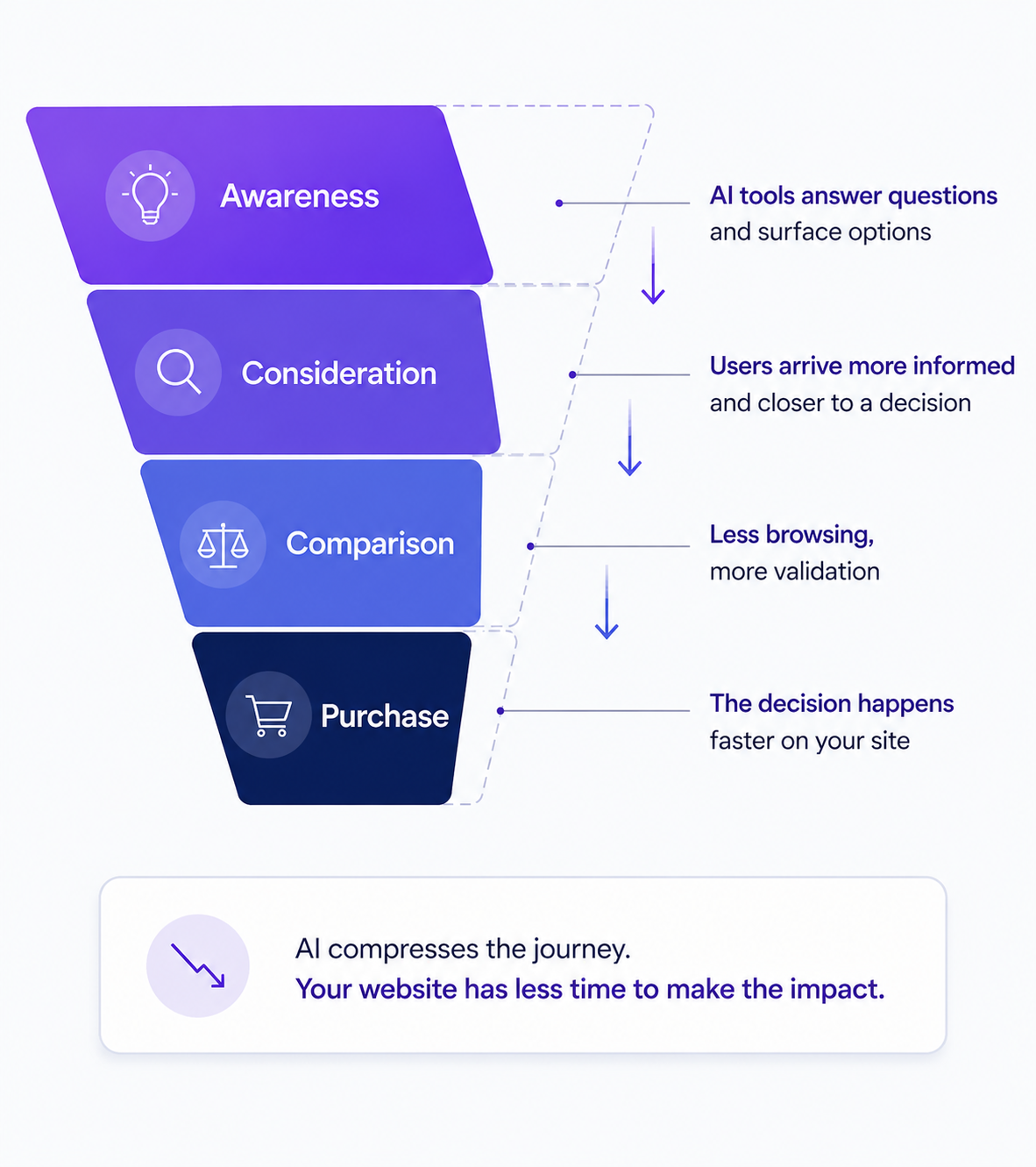
AI-driven discovery is compressing the traditional ecommerce funnel.
This broader shift is already visible in how customer behavior is shaping ecommerce, where convenience and immediacy increasingly influence buying decisions. AI is accelerating those expectations by reducing the amount of effort users expect to spend before reaching a conclusion.
The practical implication is simple: ecommerce websites now have less time to build trust and less room to create confusion.
Discovery is changing, but conversion still happens on your website
Much of the conversation around AI in ecommerce focuses almost entirely on visibility.
The discussion usually revolves around appearing in AI-generated answers, adapting to new search behavior, or understanding how discovery channels are evolving.
But discovery is only part of the equation.
Conversion still happens on ecommerce websites.
No matter how users arrive, the actual buying decision is still shaped by what happens after the click:
- whether products are explained clearly
- whether the experience feels trustworthy
- whether users can move through the journey effortlessly
- whether friction interrupts momentum
This is where many ecommerce teams misunderstand the impact of AI.
They assume AI reduces the importance of websites because it changes discovery. In reality, it often does the opposite. As AI systems reduce the amount of browsing users need to do beforehand, the quality of the on-site experience becomes more important because users arrive with clearer expectations and less patience.
The brands that benefit most from AI-driven discovery will likely not be the ones trying to manipulate algorithms. They will be the ones whose websites reduce effort most effectively once users arrive.
This starts with product pages.
Strong ecommerce product page optimization has always mattered, but AI-driven discovery changes the context around it. Product pages are no longer supporting long exploratory journeys as much as they are validating high-intent decisions.
A user arriving from an AI-generated recommendation does not want to “figure out” whether the product fits their needs. They expect the page itself to confirm the decision quickly.
If:
- sizing information is unclear
- trust signals are weak
- delivery expectations are hidden
- the value proposition requires too much interpretation
hesitation appears immediately.
And hesitation is increasingly expensive.
AI is raising expectations around user experience
One of the biggest misconceptions about AI in ecommerce is that it is purely a search or discovery story.
It is also a UX story.
AI-driven experiences condition users to expect faster answers, stronger relevance, and significantly less effort. Those expectations do not disappear when users leave an AI interface and land on an ecommerce website. They carry them directly into the experience.
That changes how friction operates.
A few years ago, users might have tolerated confusing navigation or incomplete product information because lengthy browsing was expected. Today, those same usability issues feel much more disruptive because users increasingly expect seamless, low-effort experiences throughout the entire journey.
This is where friction becomes especially important.
Friction is rarely dramatic. More often, it appears in smaller moments users themselves may not consciously notice:
- hesitation before clicking
- repeated attempts to find information
- backtracking between pages
- abandoning a flow because something simply “felt difficult”
These issues have always mattered. But compressed buying journeys make them much more visible.
That is why understanding ecommerce friction is becoming increasingly important as AI-driven discovery evolves. The more efficient discovery becomes, the more visible inefficiencies inside the website become afterward.
This is also why behavioral analysis matters more than many ecommerce teams realize.
Traditional analytics can tell you where users drop off. But they rarely explain why users hesitate in the first place. Observing actual behavior reveals the gap between what teams think users experience and what users actually experience.
And in compressed buying journeys, those gaps matter more.
The sites that win will be the ones that are easiest to understand
As AI reshapes discovery, clarity becomes a competitive advantage.
Not because ecommerce websites need to “optimize for AI,” but because both users and AI-driven systems increasingly reward experiences that reduce effort and communicate clearly.
This does not mean ecommerce teams should suddenly start writing content for algorithms. In practice, the sites that perform best are often the ones that make decisions feel simplest for humans.
That usually comes down to a few fundamentals:
- intuitive navigation
- clear category structures
- product pages aligned with intent
- seamless movement through the buying journey
This is where ecommerce website navigation and information architecture becomes far more important than many teams realize. When users arrive with stronger intent, weak structure becomes more damaging because users are less willing to “figure things out” on their own.
The same principle applies to conversion flows.
AI may help users arrive closer to a decision, but users still need a smooth path from landing page to purchase. If that path contains uncertainty, unnecessary complexity, or friction, drop-offs still happen.
That is why understanding ecommerce conversion funnels remains critical even as discovery evolves. AI may compress parts of the journey, but it does not remove the need for strong user flows afterward.
Ecommerce teams should focus less on AI tactics and more on fundamentals
The conversation around AI in ecommerce often becomes tactical too quickly.
Teams jump into discussions about automation tools, AI-generated content, and visibility tactics before fixing the fundamentals of the ecommerce experience itself.
But the biggest competitive advantage in an AI-driven environment is often not technical sophistication.
It is clarity.
As discovery journeys shrink, the websites that perform best will likely be the ones that communicate value quickly, reduce cognitive load, and help users validate decisions with minimal effort.
That requires strong operational fundamentals:
- product pages that answer real questions
- navigation that matches user expectations
- checkout experiences that feel effortless
- optimization processes grounded in actual user behavior
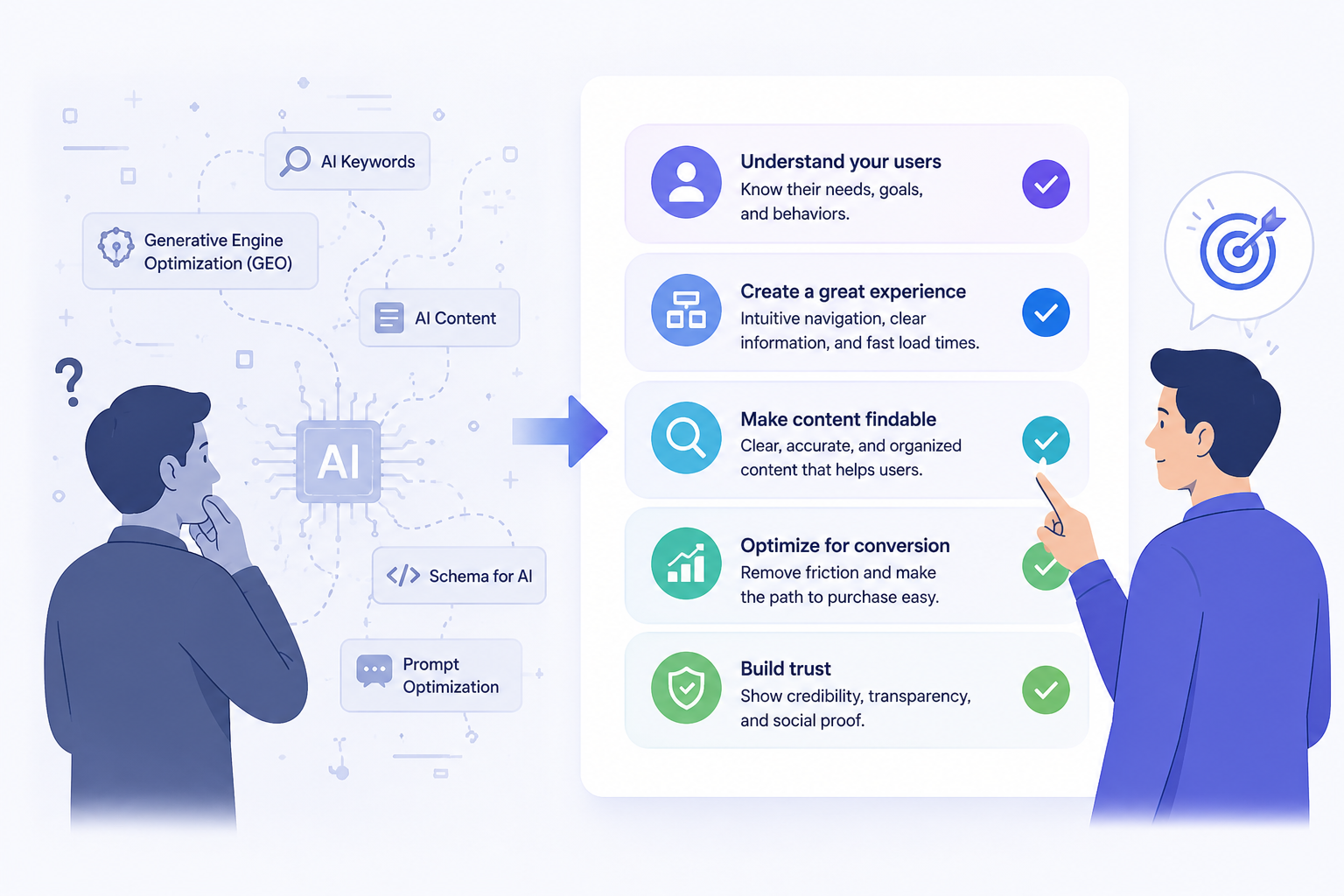
As AI reshapes ecommerce discovery, the brands that win will likely be the ones focused less on AI tactics and more on creating clear, frictionless user experiences.
This is where many ecommerce teams still go wrong.
They redesign pages based on internal opinions. They optimize around stakeholder preferences. They measure outcomes without fully understanding behaviors.
But compressed buying journeys make reactive optimization increasingly risky because users abandon poor experiences faster than before.
That is why continuous experimentation becomes more important in AI-driven ecommerce environments. Teams that consistently test, observe, and iterate adapt much faster to changing behavior than teams relying on occasional redesigns or intuition.
Many of the highest-impact improvements are surprisingly small. Changes to product hierarchy, CTA placement, form structure, or checkout clarity can create outsized effects when users arrive with stronger intent and less patience.
That is part of what makes structured ecommerce CRO testing so valuable over time: small behavioral improvements compound.
AI is changing discovery , not replacing eCommerce websites
There is a tendency to frame AI as something that will eventually replace traditional ecommerce experiences entirely.
That is probably the wrong way to think about it.
AI is changing how users discover products. It is changing how quickly they form expectations. It is changing how much effort they are willing to tolerate before leaving.
But the actual buying experience still happens on ecommerce websites.
Which means the brands that win will likely not be the ones chasing every new AI tactic or visibility trend.
They will be the ones that best understand what users need once they arrive, and remove whatever stands in the way of conversion.
Because as discovery becomes smarter, users do not become more patient.
They become less willing to tolerate experiences that fail to meet the expectations AI-driven systems are teaching them to have.