A/B testing in SaaS is the practice of running controlled experiments across your website and product to find out which version of a page, flow, or experience drives more of the outcome you care about. That might be trial sign-ups, feature adoption, plan upgrades, or reduced churn. You split your traffic, define a goal, and let real user behavior decide.
But here is what makes SaaS different from every other context where A/B testing gets discussed: you are not optimizing a single transaction. You are optimizing a chain of decisions that plays out over weeks, sometimes months. That’s why experimentation works best as part of a broader SaaS marketing strategy, where acquisition, activation, conversion, and retention are treated as connected growth levers rather than isolated goals.
A visitor becomes a trial user. A trial user becomes activated. An activated user becomes a paying customer. A paying customer either stays or leaves. Every link in that chain can be tested, improved, and compounded.
If you are completely new to experimentation, start with our guide on what A/B testing is before diving into SaaS-specific strategies.

Key takeaways
- SaaS A/B testing is different from eCommerce because the funnel is longer and success metrics change across the customer journey.
- Acquisition tests focus on trial sign-ups and conversion rates.
- Activation tests focus on onboarding, feature adoption, and time to first value.
- Retention tests focus on upgrades, engagement, and churn reduction.
- The best experiments start with real behavior data, not stakeholder opinions.
- SaaS companies often have lower traffic than eCommerce businesses, which makes statistical rigor and prioritization especially important.
- Behavior analytics tools like Mouseflow help teams understand why users behave differently during experiments, not just which version won.

What is A/B testing in SaaS
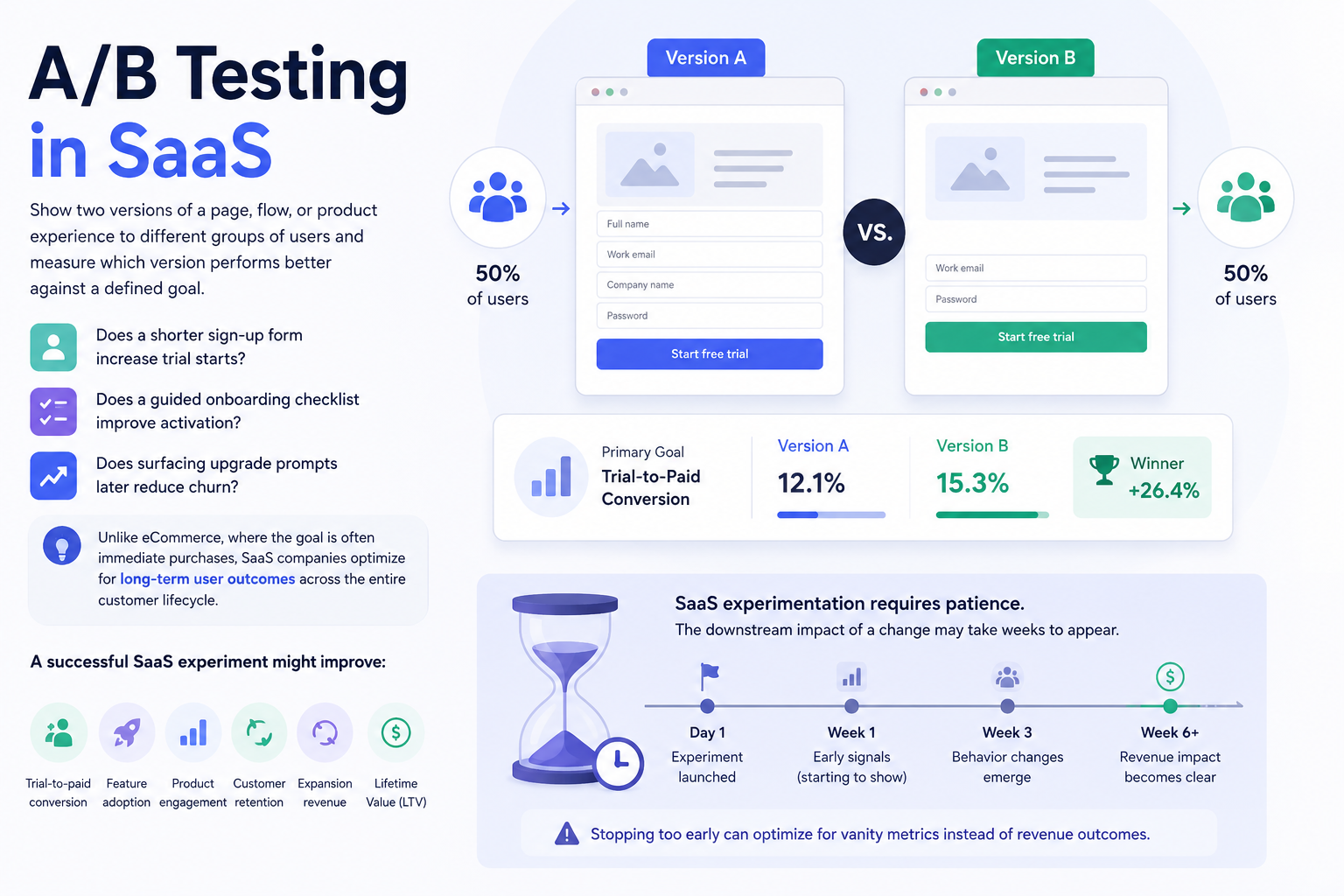
A/B testing in SaaS means showing two versions of a page, flow, or product experience to different groups of users and measuring which version performs better against a defined goal.
For example:
- Does a shorter sign-up form increase trial starts?
- Does a guided onboarding checklist improve activation?
- Does surfacing upgrade prompts later reduce churn?
Unlike eCommerce, where the goal is often immediate purchases, SaaS companies optimize for long-term user outcomes across the entire customer lifecycle.
A successful SaaS experiment might improve trial-to-paid conversion, feature adoption, product engagement, expansion revenue, customer retention and the lifetime value (LTV).
This is also why SaaS experimentation requires patience. The downstream impact of a change may take weeks to appear.
For example, a new onboarding flow might initially increase trial sign-ups while quietly reducing activation quality. If you stop the test too early, you risk optimizing for vanity metrics instead of revenue outcomes.
Why SaaS companies invest heavily in A/B testing
The biggest reason is simple: compounding growth. Small improvements across the funnel create outsized revenue impact over time. Improve trial sign-ups by 10%, activation by 8%, and retention by 5%, and those gains compound together to increase recurring revenue without increasing acquisition spend.
It reduces the risk of bad product decisions. Product and growth teams make assumptions constantly. A/B testing validates changes with real users before rolling them out broadly. That matters because bad SaaS decisions can quietly damage retention for months before anyone notices. A confusing onboarding flow, poorly timed upgrade prompt, or frustrating UX pattern may not immediately hurt revenue, but it can suppress activation and retention across entire cohorts. Testing helps teams catch those issues early.
It creates alignment across teams. Product, design, growth, and leadership teams often have competing opinions about what users want. Good experimentation creates a shared source of truth. Instead of debating ideas endlessly, teams can use behavioral evidence and test outcomes to guide decisions faster.
It builds institutional knowledge about your users. Every test teaches you something specific: what messaging resonates, which friction points block progress, which features users value most, and what drives commitment and retention. Over time, those learnings compound into a much stronger understanding of your audience.
What to A/B test across the SaaS funnel
One of the most common mistakes SaaS companies make is treating all experiments the same.
The reality is that different stages of the funnel require completely different testing strategies. A homepage test designed to increase clicks may have little impact on activation. Likewise, an onboarding experiment may not improve acquisition at all.
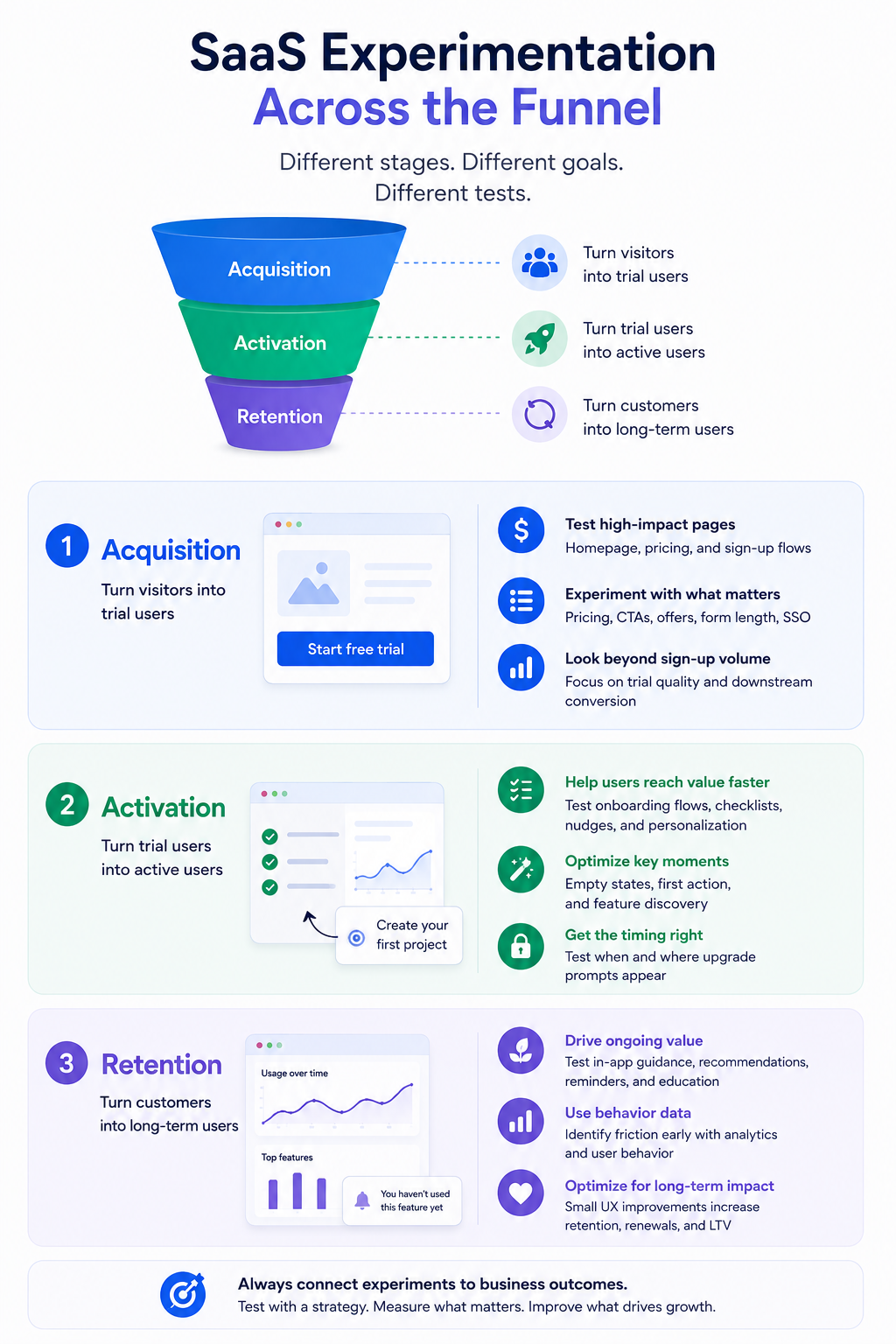
The most effective SaaS experimentation programs think about testing in three stages: acquisition, activation, and retention.
Acquisition: turning visitors into trial users
Acquisition experiments focus on converting traffic into sign-ups, demos, or free trials. This is where most SaaS teams begin because homepage traffic and pricing page traffic are often the easiest areas to test quickly.
Pricing pages are especially important because small changes in structure or messaging can dramatically influence conversion behavior. Many SaaS companies experiment with plan order, annual pricing visibility, CTA wording, and how recommended plans are highlighted.
For example, one company may discover that showing annual pricing by default increases yearly subscriptions, while another learns that emphasizing “No credit card required” improves trial volume. Some teams find that positioning enterprise plans first makes mid-tier plans feel more affordable through anchoring psychology.
Sign-up flows are another major area of experimentation. Every additional form field introduces friction, which is why SaaS companies often test shorter forms, Google SSO, delayed password creation, or multi-step flows.
But the goal is not always maximizing raw sign-up volume.
Some companies discover that asking for more information upfront reduces total sign-ups while improving trial quality and sales conversion later in the funnel. That is why SaaS experimentation should always connect back to business outcomes rather than vanity metrics alone.
Activation: turning trial users into active users
Activation is where many SaaS companies lose the majority of potential customers.
A user who signs up but never experiences value is unlikely to convert to paid, regardless of how effective the homepage or pricing page is. That makes onboarding and activation one of the highest-leverage areas for experimentation.
Many SaaS companies test different onboarding approaches to help users reach value faster. Some experiment with guided checklists instead of product tours. Others simplify setup flows, introduce contextual nudges, or personalize onboarding based on user intent.
For example, a project management platform might test whether users activate faster when they create a project immediately instead of watching a feature walkthrough first. Another SaaS company might discover that onboarding emails improve feature adoption during the first week after sign-up.
Empty states are another overlooked testing opportunity. These are the screens users see before they have added data, configured workflows, or invited teammates. A blank interface creates uncertainty, while a strong empty state shows users what success looks like and what they should do next.
Feature gating also plays a major role in SaaS experimentation. Timing matters enormously here. Upgrade prompts shown too early can frustrate users before they experience value, while prompts shown too late may fail to communicate the benefits of premium functionality.
The most effective SaaS teams carefully test how, when, and where upgrade moments appear inside the product experience.
Retention: turning customers into long-term users
Retention experiments are less common than acquisition tests, but they are often far more valuable.
By this point, users already trust the product. Small UX improvements can meaningfully affect renewals, engagement, expansion revenue, and customer lifetime value.
One of the biggest retention challenges in SaaS is feature discovery. Many users churn not because the product lacks value, but because they never discover the functionality most relevant to them.
That is why SaaS companies often experiment with in-app guidance, personalized recommendations, usage reminders, onboarding extensions, and contextual education flows. The goal is to help users continuously uncover value over time rather than only during onboarding.
Behavior analytics becomes especially useful here because it reveals frustration patterns long before cancellation happens.
Rage clicks, abandoned workflows, repeated dead clicks, and confusing navigation patterns often reveal friction before users ever contact support or churn. Instead of guessing why retention suffers, teams can directly observe user behavior and test improvements accordingly.
This is where experimentation becomes less about conversion optimization and more about experience optimization.
How behavior analytics helps SaaS teams prioritize tests
Knowing what to test is often harder than running the experiment itself.
WP Engine, a leading WordPress technology provider, is a strong example of how behavior analytics helped uncover the right optimization opportunities.
Before using Mouseflow, their Web Strategy team assumed users were ignoring enterprise content because the messaging was weak. Heatmaps revealed something completely different. Users were not ignoring the page at all, they simply were not seeing it because it was buried inside a dropdown menu.
After moving the enterprise page into the main navigation, WP Engine saw a 6% increase in total navigation clicks.
The team also used feedback surveys to improve support content and reduce friction inside their help experience, contributing to a 27% reduction in support contact rates.
That is what strong behavior analytics does for SaaS experimentation. It removes guesswork and helps teams identify high-impact opportunities much faster.

“We didn’t need a separate development resource for feedback. Mouseflow handled it for us.”
A/B testing tools for SaaS teams
Most SaaS experimentation stacks combine three things: an experimentation platform, product analytics, and behavior analytics. Platforms like Optimizely, Varify, and AB Tasty help teams run controlled experiments and measure outcomes. Product analytics tools help track activation, engagement, and conversion metrics across the user journey.
But experiment results alone rarely explain why users behaved differently. That is where behavior analytics becomes valuable. Session replays, heatmaps, funnel analysis, and feedback tools help teams understand the friction, hesitation, and UX patterns behind the numbers. This is especially important in SaaS because user behavior is often more complex than a simple purchase journey.
FAQs

eCommerce usually optimizes immediate purchases, while SaaS optimizes a much longer journey involving sign-up, activation, upgrades, and retention.
That depends on the funnel stage. Acquisition tests may focus on sign-up rates or cost per acquisition, while onboarding tests often measure activation or time to value. Retention experiments usually focus on churn, engagement, or expansion revenue.
Most SaaS experiments should run for at least two weeks and ideally until reaching statistical significance with enough traffic volume to produce reliable conclusions.
Yes. Most mature SaaS companies run experiments continuously across pricing pages, onboarding flows, feature discovery, upgrade prompts, lifecycle emails, and product UX.
Indirectly, yes. Experiments that improve onboarding, reduce friction, increase feature discovery, and help users experience value faster often contribute to higher retention over time.