
Customer Satisfaction Score (CSAT) measures how satisfied users are with a specific interaction, and you improve it by identifying and removing friction in that exact moment.
Most teams have no trouble collecting the score itself. The challenge is understanding what actually drove that response and what to change to improve it. A number alone won’t tell you why a user felt frustrated during checkout or confused during onboarding.
To make CSAT actionable, you need to tie feedback to real behavior: where users hesitate, struggle, or drop off. When you can see what happened before the score was given, you can move from measuring satisfaction to systematically improving it.
In this article, we’ll break down what CSAT really measures, where to collect it for meaningful insights, and, most importantly, how to turn that feedback into concrete improvements that actually move your score.
Read more about User Feedback here.

What is Customer Satisfaction Score (CSAT)?
Customer Satisfaction Score (CSAT) is a targeted metric that measures how happy a user is with a specific interaction. Think checkout, onboarding, or a support ticket.
You ask one simple question: “How satisfied were you with this experience?”
They answer on a numeric scale, typically 1 to 5. To calculate CSAT, take the number of positive responses (usually 4s and 5s), divide it by the total number of responses, and multiply by 100. If 80 out of 100 users rate their experience a 4 or 5, your CSAT is 80%.
If you want to improve response quality, it is worth using well-tested survey questions that make it easier for users to answer quickly and clearly
Where CSAT fits alongside other CX metrics
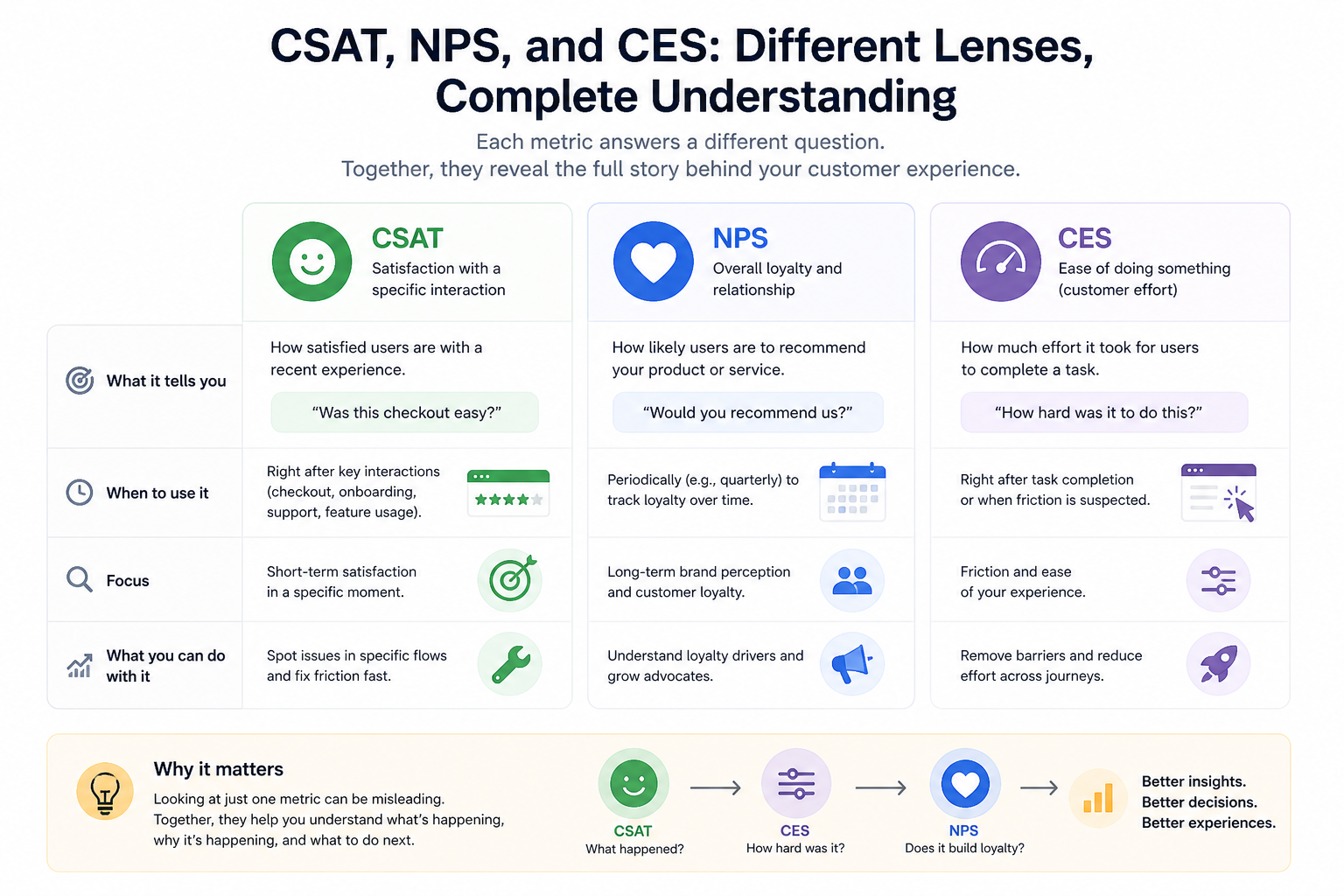
CSAT is not a lone wolf. It works best when paired with other customer experience metrics, because each one answers a different question about the user experience:
- CSAT measures specific moments: “Was this checkout easy?”
It tells you how a particular interaction felt right after it happened. - NPS measures overall loyalty: “Would you recommend us?”
It reflects how users feel about your brand as a whole, not a single experience. - CES measures friction: “How hard was it to do this?”
It helps you understand friction, often before it shows up as dissatisfaction.
Used together, these metrics give you a much clearer picture. For example, you might have a high NPS but a low CSAT on checkout, meaning people like your product overall, but a specific journey is broken. Or a good CSAT but high effort (CES), which signals a hidden problem that could hurt satisfaction over time.
In short, CSAT shows you where the experience worked (or didn’t), CES explains how difficult it was, and NPS tells you whether it matters in the long run.
When to collect CSAT feedback
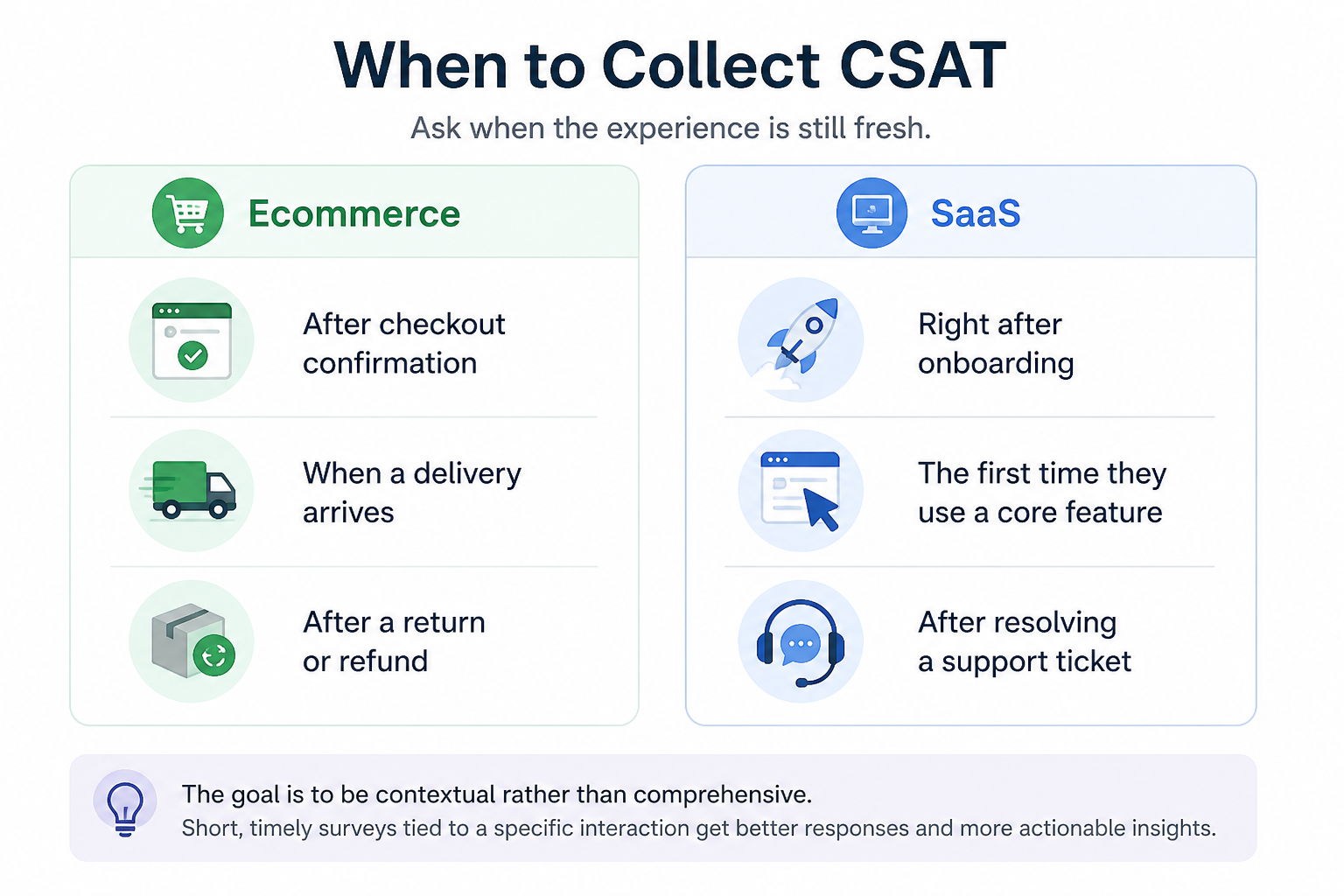
Timing is everything. Send a survey three days later… you are measuring a memory, not a feeling.
Ask immediately after a meaningful task completion.
For ecommerce, collecting feedback at the right moment in the journey, especially on product and checkout pages, can uncover friction that directly impacts conversions.
CSAT benchmarks worth knowing
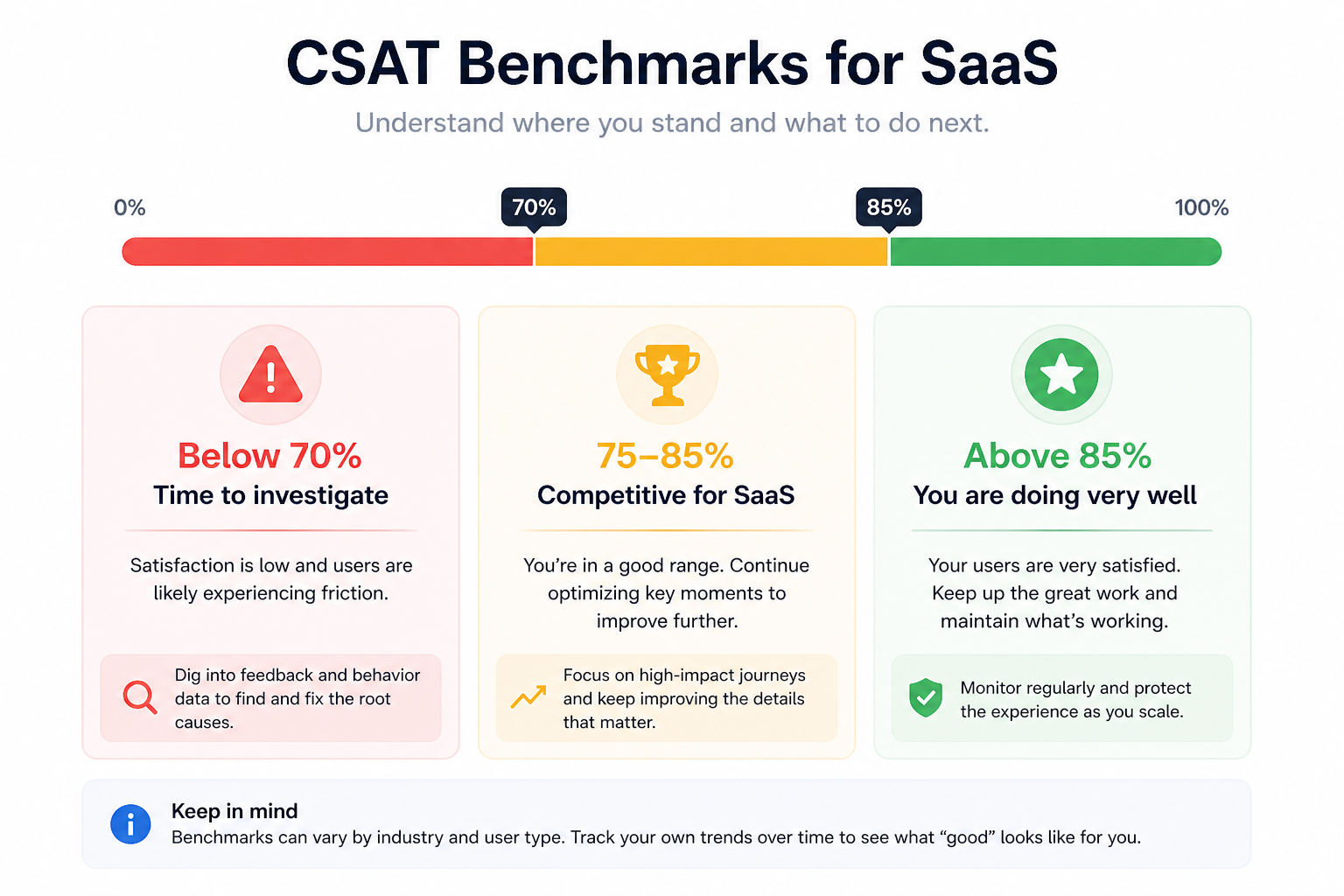
Everyone wants to know if their score is “good.”
- Below 70% → Time to investigate
- 75 – 85% → Competitive for SaaS
- Above 85% → You are doing very well
For ecommerce, external benchmarks are noisy. Your best benchmark is your own historical data. Track your baseline and aim to beat it.
5 ways to actually improve your CSAT
Improving your CSAT isn’t about collecting more feedback, it’s about acting on the right signals.
Most satisfaction drops come from a few specific friction points, not the entire experience. If you can identify and fix those moments, your score will follow.
Here are five practical ways to do exactly that.
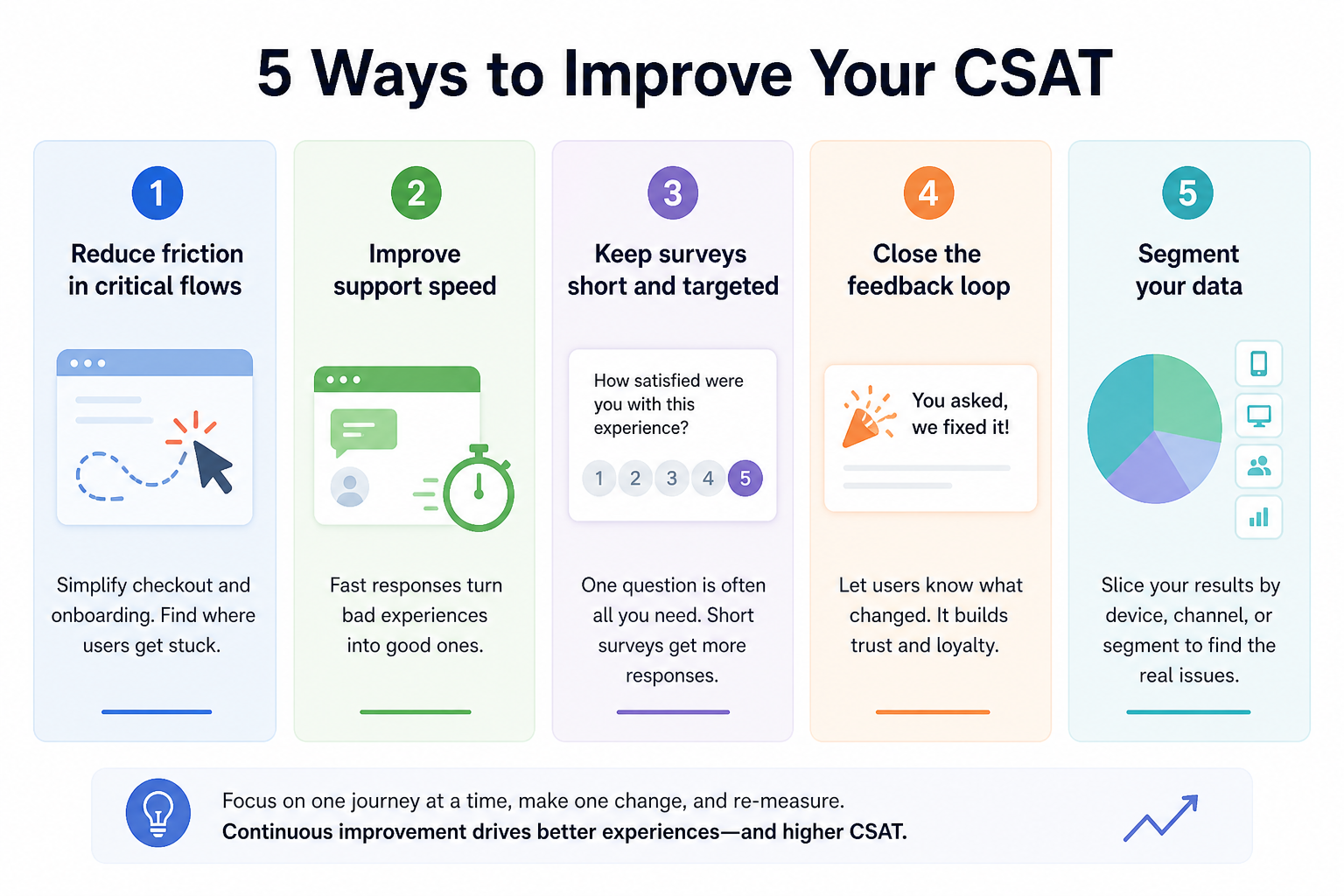
1. Reduce friction in critical flows
Simplify checkout and onboarding. Friction drags down satisfaction faster than anything else. Use session replay tools to see exactly where users struggle.
2. Improve support speed
Fast responses fix bad experiences. Users forgive software bugs. They do not forgive being ignored, especially in support-driven interactions, which heavily influence CSAT.
3. Keep surveys short and targeted
One question. That is it. Long surveys get abandoned.
4. Close the feedback loop
Tell users you fixed what they complained about. An in-app message saying “You asked, we fixed” builds trust.
5. Segment your data
A general CSAT of 80% hides the real issues. Break it down by device, traffic source, or customer segment.
And once you collect enough feedback, knowing how to analyze it properly is what turns insights into action.
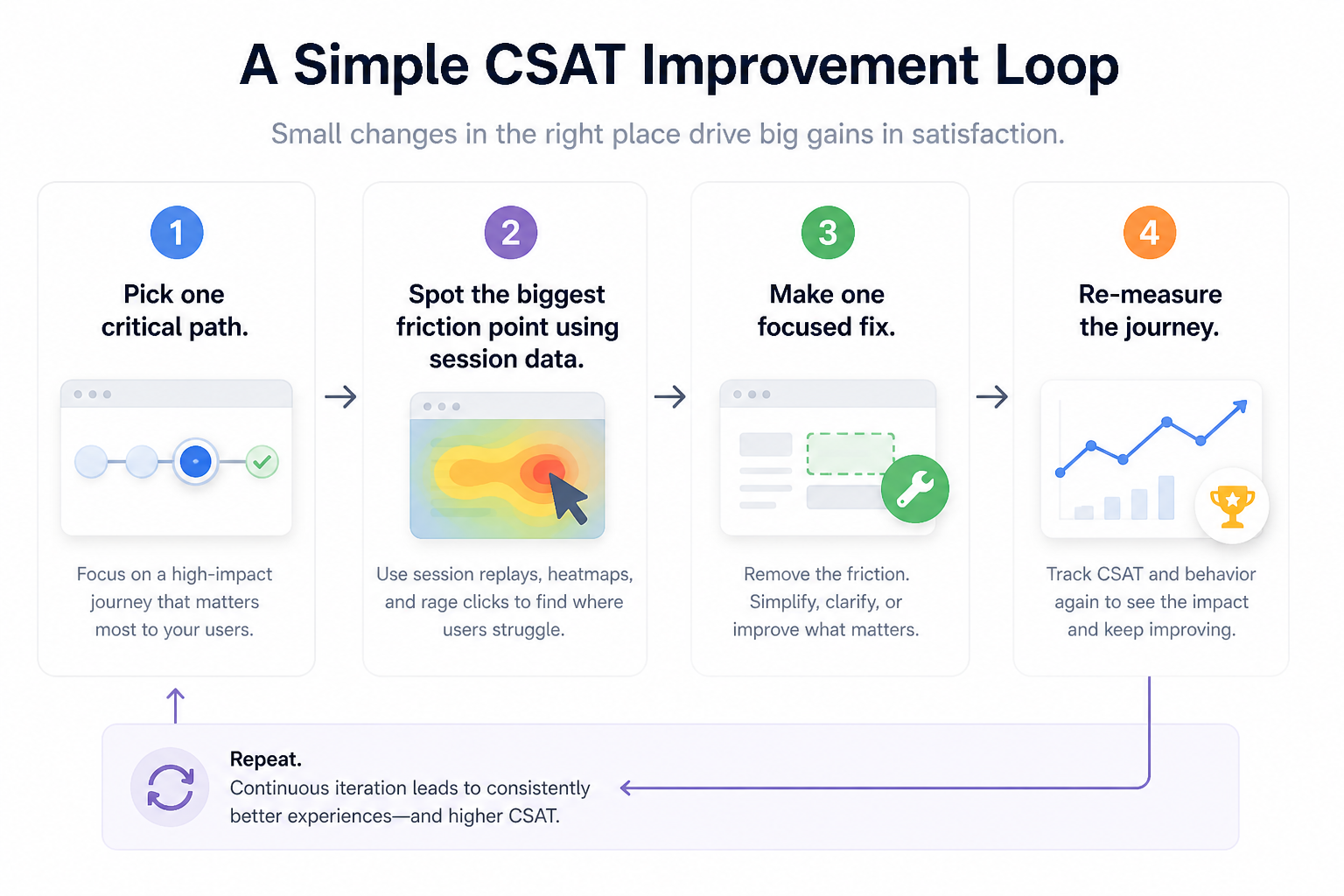
A simple CSAT measurement playbook
Do not try to fix everything at once. Focus on one journey.
- Pick one critical path.
- Spot the biggest friction point using session data.
- Make one focused fix.
- Re-measure the journey.
Before you change your ecommerce checkout, look at user behavior analytics to see if the issue is form complexity or shipping costs. Fixing the wrong thing wastes time.
Mouseflow makes this easy. See exactly what happens before a user leaves. Our session replays, heatmaps, and friction scores give you the ‘why’ behind your CSAT score.
Beatriz Andrade is a Campaign Marketing Manager at Mouseflow, where she develops and executes campaigns to drive growth for one of the leading behavioral analytics platforms.